Digitalowl
- Home
- Why Beginners Should Build Small Projects Before Learning Everything
- What to Power First During a 72-Hour Blackout
Recent posts
-
2,000W vs 2,000Wh: Why These Specs Mean Different Things
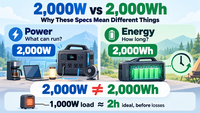
A portable power station advertised as 2,000W is not necessarily equipped with a 2,000Wh battery. Although the numbers look similar, watts (W) measure power, while watt-hours (Wh) measure energy. They describe different parts of how an energy storage system performs. A 2,000W output rating tells you how much electrical power the station can continuously supply under specified conditions. A 2,000Wh…
- battery
- electricity
- +2
-
1,000Wh vs 2,000Wh Power Station: What Changes in Real Use?
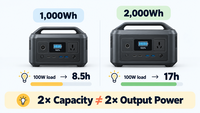
A 2,000Wh portable power station stores approximately twice as much energy as a 1,000Wh model. But twice the battery capacity does not automatically mean twice the output power, faster charging or better performance in every situation. The most significant difference is how long the station can support connected equipment. A larger battery may keep a refrigerator running longer, provide more reser…
- batteries
- electricity
- +4
-
How Much Battery Capacity Does Starlink Need During an Outage?
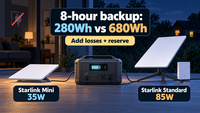
How Much Battery Capacity Does Starlink Need During an Outage? Starlink can provide internet connectivity when conventional wired networks are unavailable, but the terminal, router and power supply still require electricity. During a power outage, a portable power station or backup battery can keep the system operating if it delivers sufficient energy and compatible electrical power. The battery c…
- backup-power
- batteries
- +2
-
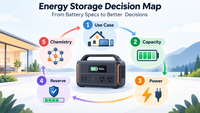
Decision Tools for Energy Storage: Turning Battery Specs Into Better Choices
A portable power station may advertise 2,000Wh of battery capacity, 2,400W continuous output, 4,000 charge cycles and multiple charging options. Every specification provides useful information, but none independently tells you whether the system is suitable for a particular application. The real challenge is not finding more battery specifications. It is turning technical measurements into practic…
- battery
- energy
- +5
-
How Much Battery Capacity Does a Well Pump Need?
A well pump can provide essential household water during a power outage, but running it from a battery requires more than matching the pump's wattage to a portable power station. Well pumps can demand substantial startup power even when their total daily energy consumption is relatively modest. The battery capacity you need depends on the pump's actual electrical input, operating time, water cons…

- battery
- energy
- +5
-
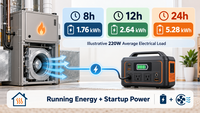
How Much Battery Capacity Does a Furnace Blower Need?
A gas furnace can produce heat using natural gas or propane, but its blower motor, control board and ignition components still need electricity. During a power outage, a battery backup system may keep the heating system operating even when the utility grid is unavailable. The battery capacity required depends on the furnace's electrical consumption, blower operating time, startup power and desire…
- battery
- energy
- +3
-
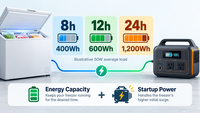
How Much Battery Capacity Does a Freezer Need During an Outage?
A freezer can often maintain a safe temperature for several hours without electricity, especially when it is full and the door stays closed. But during longer power outages, a portable power station or home battery system may be needed to keep the compressor operating. The battery capacity required depends on the freezer's actual energy consumption, outage duration, inverter losses, startup power …
- battery
- electricity
- +4
-
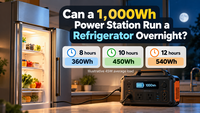
Can a 1,000Wh Power Station Run a Refrigerator Overnight?
Yes, a 1,000Wh portable power station can run many refrigerators overnight, but the result depends on actual refrigerator energy consumption, inverter losses, standby power and the number of hours you need. A battery labelled 1,000Wh does not necessarily deliver the full 1,000Wh to an AC appliance. A relatively efficient refrigerator may require only a few hundred watt-hours during an eight-hour p…
- electricity
- energy
- +3
-
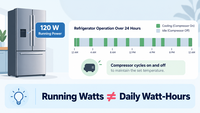
Why Refrigerator Running Watts Can Overestimate Daily Energy Use
A refrigerator may draw 120 W while its compressor is running, but that does not mean it consumes 120 W continuously for 24 hours. If you multiply its running power by an entire day, you may significantly overestimate the energy required to keep it operating. The reason is simple: many refrigerators operate in cycles. Their compressors switch on when cooling is needed and switch off after the targ…
- electricity
- energy
- +3