Airline Battery Limits in Watt-Hours: How to Check Before You Fly
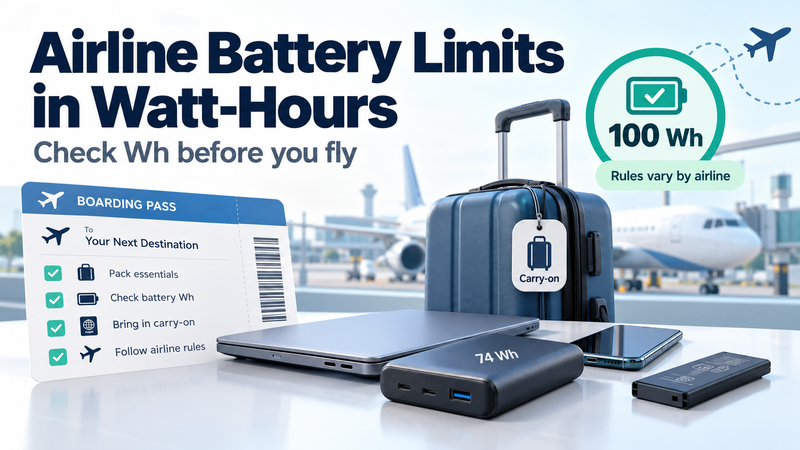
Airlines regulate lithium batteries primarily by watt-hours (Wh) rather than by mAh. That matters for phones, laptops, cameras, drones and especially power banks because Wh describes stored energy and allows batteries with different voltages to be compared on the same scale.
The practical rule is simple: find the Wh rating before you fly, identify whether the battery is installed or spare, and then check the current rules of your airline and departure/destination authorities.
For the broader battery-capacity framework:
https://medium.com/@volodymyrzh/battery-capacity-explained-mah-wh-amp-hours-decoded-1dc676be5a38
Why Airlines Use Watt-Hours
mAh alone does not tell you how much energy a battery stores because voltage is missing.
Watt-hours include both charge capacity and voltage:
Wh = Ah × V
For a battery labelled in mAh:
Wh = (mAh ÷ 1,000) × V
This gives airlines and safety authorities a consistent way to classify lithium-ion batteries regardless of whether they are used in a phone, laptop, camera or power bank.
For a deeper explanation of Wh:
https://digitalowl.fika.bar/what-is-a-watt-hour-wh-explained-simply-01M2GM471S7BVV7BQ4R37DEEAP
The Common 100 Wh Threshold
For many passenger lithium-ion batteries, 100 Wh is the key reference point.
Under FAA rules, lithium-ion batteries up to 100 Wh are generally allowed for personal use. Batteries above 100 Wh and up to 160 Wh may require airline approval, while batteries above 160 Wh are generally not permitted as normal passenger baggage.
But this should not be treated as a universal rule for every airline, country or battery type.
Current IATA guidance is stricter specifically for power banks: passengers are advised to carry no more than two lithium-ion power banks, each not exceeding 100 Wh.
Airlines can impose additional restrictions.
Power Banks Need Special Attention
A power bank is generally treated as a spare lithium battery, not simply as an electronic device with an installed battery.
That distinction affects where it can be packed.
Power banks and spare lithium batteries are normally required to stay in carry-on baggage rather than checked baggage.
The reason is safety: if a battery overheats or enters thermal runaway in the cabin, the crew can identify and respond to the problem more quickly than if it occurs inside the cargo hold.
Current IATA guidance also states that power banks should not be stored in overhead lockers and should not be recharged from an aircraft power supply. Airlines may impose even stricter conditions.
Before flying, always verify the policy of the specific carrier.
How to Calculate the Wh of a Power Bank
Power banks are often advertised primarily in mAh.
Suppose a power bank is labelled:
20,000 mAh
and its internal battery voltage is:
3.7 V
Convert mAh to Ah:
20,000 mAh ÷ 1,000 = 20 Ah
Then:
20 Ah × 3.7 V = 74 Wh
So the power bank is approximately 74 Wh.
A 10,000 mAh power bank at 3.7 V is approximately:
10 Ah × 3.7 V = 37 Wh
A 26,800 mAh power bank at 3.7 V is approximately:
26.8 Ah × 3.7 V ≈ 99.2 Wh
That last example shows why many high-capacity travel power banks cluster just below 100 Wh.
For more detail on how power-bank capacity is expressed:
https://digitalowl.fika.bar/power-bank-capacity-explained-mah-wh-and-real-usable-energ-01M499K9445MBB8D2DYYWJ4BE2
Do Not Calculate Wh From USB Output Voltage
This is an easy mistake.
A power bank may advertise USB output at 5 V, 9 V, 12 V or 20 V. Those are output voltages produced by its conversion electronics.
The battery's Wh rating is based on the battery specification, not simply the voltage shown beside a USB port.
If the manufacturer prints a Wh value on the product, use that figure.
If Wh is missing, use the battery's stated nominal voltage and Ah or mAh rating.
Do not assume 5 V simply because the power bank has a standard USB output.
What About a Laptop Battery?
Laptop batteries commonly list their capacity directly in Wh.
A typical example might be:
60 Wh
That makes the classification straightforward because no conversion is required.
A laptop battery installed inside the laptop is also treated differently from a loose spare battery.
Authorities may permit some battery-powered devices in checked baggage under specified conditions, but cabin carriage is generally preferred and airlines may impose their own requirements.
If a device must be checked, requirements can include completely switching it off and protecting it against accidental activation and damage.
Installed Battery vs Spare Battery
This distinction is crucial.
An installed battery is contained inside the device it powers.
Examples:
phone battery;
laptop battery;
camera battery installed in the camera.
A spare battery is carried separately.
Examples:spare camera battery;
removable laptop battery carried by itself;
power bank;
portable charger.
Spare lithium batteries generally face stricter packing rules and should be individually protected against short circuits.
Exposed terminals should not be allowed to contact coins, keys or other conductive objects.
What Happens Between 100 Wh and 160 Wh?
This is where checking the exact rule becomes essential.
Under current FAA passenger guidance, certain lithium-ion batteries between 101 and 160 Wh may be carried with airline approval, with limits applying to larger spare batteries.
However, current IATA 2026 guidance treats power banks differently and lists power banks above 100 Wh and up to 160 Wh as forbidden.
That means seeing “under 160 Wh” on an old travel guide is not enough to decide whether your power bank can fly.
You need to know:
what type of battery it is;
whether it is installed or spare;
which regulator applies;
which airline you are flying with.
Batteries Above 160 Wh
Large lithium batteries above 160 Wh generally fall outside normal passenger-baggage allowances.
This category can include large portable power stations, some professional equipment batteries and many backup-energy products.
A 500 Wh or 1,000 Wh portable power station is not simply a large version of a travel power bank from an aviation perspective.
Such batteries may require cargo procedures rather than passenger baggage transport.
Do not arrive at the airport assuming airline approval alone will solve the issue.
Why the Label Matters
Airport staff need to identify the battery's rating.
A clearly printed specification such as:
Capacity: 74 Wh
is much easier to evaluate than a casing that shows only a marketing name or an unreadable battery label.
When buying a power bank specifically for travel, it is useful to choose a model with a clearly visible Wh rating.
If only mAh and voltage are printed, calculate Wh before travelling and keep the manufacturer specification available if necessary.
Damaged Batteries Are a Different Problem
Capacity is not the only safety consideration.
A battery that is swollen, damaged, recalled, leaking, unusually hot or otherwise defective can be prohibited regardless of whether it is below the normal Wh limit.
Do not travel with a visibly damaged power bank or battery simply because its capacity is within the numerical threshold.
A Practical Pre-Flight Battery Check
Before travelling with a lithium battery:
Find its Wh rating.
If only mAh is listed, find the nominal battery voltage and calculate Wh.
Determine whether it is installed in a device, a spare battery or a power bank.
Keep spare batteries and power banks in carry-on baggage.
Protect exposed terminals from short circuits.
Check whether your airline imposes quantity or usage restrictions.
Check current national or regional aviation rules.
Do not rely on an old “100 Wh / 160 Wh” infographic without verifying the current policy.
For current passenger guidance, useful official starting points are:
https://www.iata.org/en/youandiata/travelers/batteries
https://www.faa.gov/hazmat/packsafe/lithium-batteries
The Practical Rule
Wh tells you which capacity category the battery belongs to. It does not, by itself, guarantee that the battery will be accepted.
For many small consumer batteries, staying at or below 100 Wh keeps the situation relatively simple.
Above 100 Wh, restrictions become more significant and increasingly dependent on the battery type, regulator and airline.
Power banks deserve particular attention because current rules can be stricter than the rules for batteries installed in equipment.
So before a flight, calculate the Wh, read the label, keep spare lithium batteries in the cabin, and check the current policy of the actual airline you are flying with.
Comments
No comments yet. Be the first to comment!