How to Compare Portable Power Stations Without Focusing on the Wrong Specs
Practical advices
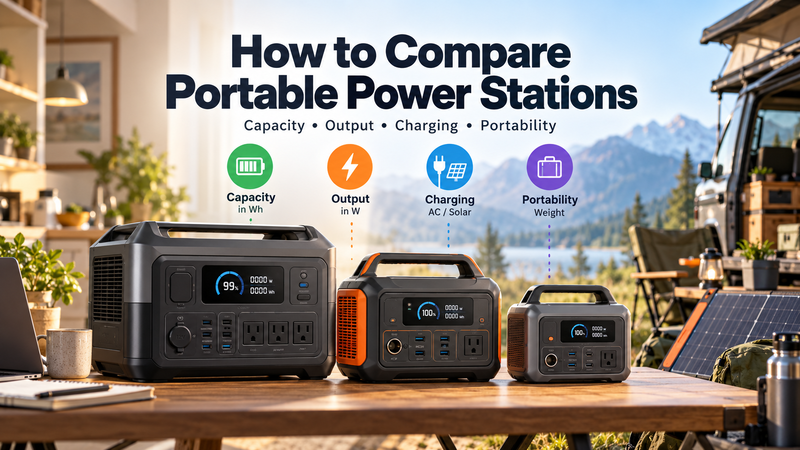
Portable power stations are easy to compare badly.
One model may advertise 1,000 Wh. Another highlights 1,800 W output. A third promotes 3,000 cycles, fast charging or expandable batteries. All of those numbers can matter, but they answer different questions.
The useful comparison is not “Which specification is biggest?” It is which specification matters for your use case.
For the broad battery-capacity framework:
https://medium.com/@volodymyrzh/battery-capacity-explained-mah-wh-amp-hours-decoded-1dc676be5a38
Start With Capacity in Watt-Hours
Battery capacity tells you how much energy is stored.
A portable power station rated at:
1,000 Wh
stores roughly twice as much nominal energy as a:
500 Wh
unit.
That does not mean it can power every appliance, and it does not mean you will receive every rated watt-hour at the outlet.
But Wh is the correct starting point for questions such as:
how long can this station support a load?
how many device charges could it provide?
is it sized for a few hours or a full day?
A fuller explanation of portable power station capacity is here:
https://digitalowl.fika.bar/portable-power-station-capacity-explained-01M418WTCRZQBSBGP2JVK082W9
Rated Capacity Is Not the Same as Usable Energy
Two stations with the same advertised Wh can deliver different real-world energy.
Losses can come from:
inverter conversion;
DC conversion;
internal electronics;
standby consumption;
thermal management;
battery-management limits.
So a 1,000 Wh rating should not automatically be interpreted as 1,000 Wh delivered to an AC appliance.
For realistic comparisons, look for independent runtime testing or manufacturer data that clearly describes usable output under defined conditions.
This is one reason portable power station comparisons should separate nominal capacity from usable energy.
Continuous Output Answers a Different Question
Capacity tells you how much energy is stored.
Continuous output tells you how much power the inverter can provide at one time.
A station may store 1,500 Wh but have a continuous AC output of only 1,000 W.
That means it may run a 100 W device for many hours but still be unable to support an appliance requiring 1,500 W continuously.
Continuous output therefore determines whether the load is compatible in the first place.
For more detail:
https://digitalowl.fika.bar/what-is-continuous-power-output-01M2JYJBJJHR19Q9ZVAPNTN5GX
Surge Output Matters for Motors and Compressors
Some appliances briefly require much more power at startup than during normal operation.
Examples can include:
refrigerators;
pumps;
compressors;
certain power tools;
some air-conditioning equipment.
A portable power station can have enough continuous output for the appliance's normal load and still shut down during startup if the surge exceeds its limit.
When comparing stations for these loads, check:continuous output;
surge or peak output;
how long the station can sustain that surge;
the actual startup requirement of the appliance.
Do not compare surge numbers as if they were normal operating power.
Capacity and Output Should Be Checked Together
Consider two simplified stations:
Station A: 2,000 Wh capacity, 1,000 W continuous output.
Station B: 1,000 Wh capacity, 2,000 W continuous output.
Which is better?
Neither specification set is universally better.
Station A may provide longer runtime for moderate loads.
Station B may operate higher-power appliances despite storing less total energy.
That is why a useful decision starts with:
What must the power station run, and for how long?
Then capacity and output can be evaluated together.
Cycle Life Matters When the Station Will Be Used Frequently
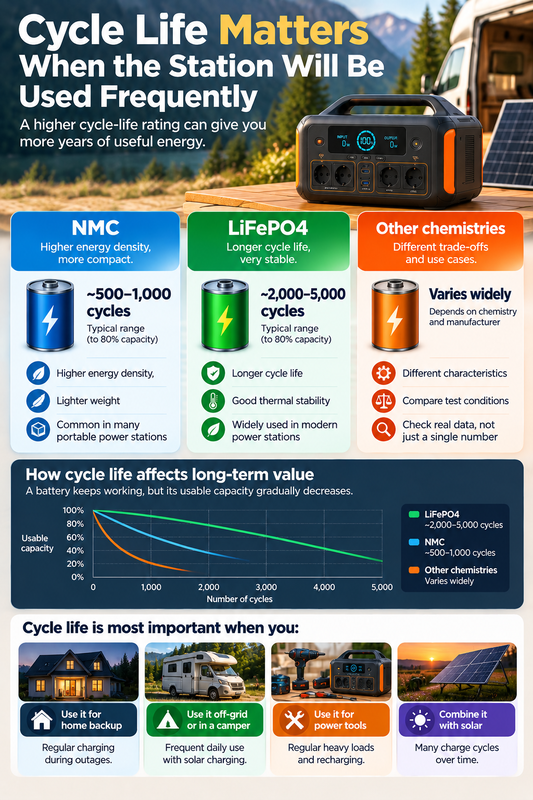
Cycle life estimates how many charge-discharge cycles a battery can complete before reaching a specified retention threshold.
A higher cycle-life rating can be valuable for:
frequent backup use;
off-grid operation;
daily charging;
regular camping or van use;
systems used alongside solar.
But cycle-life numbers are meaningful only when the test conditions are comparable.
A claim of 3,000 cycles does not automatically outperform a claim of 2,000 cycles if the manufacturers use different depth-of-discharge, temperature or capacity-retention thresholds.
Battery cycle life is explained here:
https://digitalowl.fika.bar/what-is-battery-cycle-life-01M2YNVWHAW1CQ4D7CFQ9DSEHH
Chemistry Can Influence Weight, Size and Longevity
Portable power stations commonly use lithium-based chemistries such as LiFePO4 or NMC.
Chemistry can influence:
energy density;
cycle life;
weight;
thermal characteristics;
pack design.
But chemistry should not be used as a single winner-takes-all specification.
A higher-energy-density pack may provide more energy for a given weight or volume. Another chemistry may prioritise cycle life or other design characteristics.
Energy density and total capacity are related but different concepts:
https://www.linkedin.com/pulse/energy-density-vs-battery-capacity-what-matters-storage-zhyliaev-rzyif/
A compact station with high energy density is not automatically better if your priority is long cycle life, expandability or high output.
Charging Speed Can Change the User Experience
Recharge time becomes important when the station is used repeatedly.
Compare:
maximum AC charging input;
solar input;
vehicle charging capability;
supported voltage/current ranges;
whether several charging sources can operate together.
A 1,000 Wh station that takes many hours to recharge behaves very differently from one that can recover most of its energy quickly between outages or travel stops.
But a large charging wattage should still be considered relative to battery capacity.
A 1,000 W charging input means something different on a 500 Wh battery than on a 4,000 Wh battery.
Solar Input Is More Than a Wattage Number
If solar charging matters, do not compare only the headline solar-watt figure.
Also check:
accepted voltage range;
maximum current;
connector compatibility;
MPPT limits;
realistic panel configuration.
Two stations may both advertise 500 W solar input but support different panel arrangements.
The charging specification should match the solar setup you actually plan to use.
Expandability Can Be More Valuable Than Oversizing Today
Some power stations support additional battery modules.
That changes the purchase decision.
Instead of buying the largest possible system immediately, you may be able to start with a smaller base unit and add capacity later.
Expandability is especially useful when:
future energy needs are uncertain;
outage duration may increase;
a van or off-grid system is being built gradually;
budget is spread across several stages.
But expansion batteries add cost, weight and complexity, so compatibility and maximum supported capacity should be checked before assuming the system can grow indefinitely.
Weight Matters More Than It Looks on a Specification Sheet
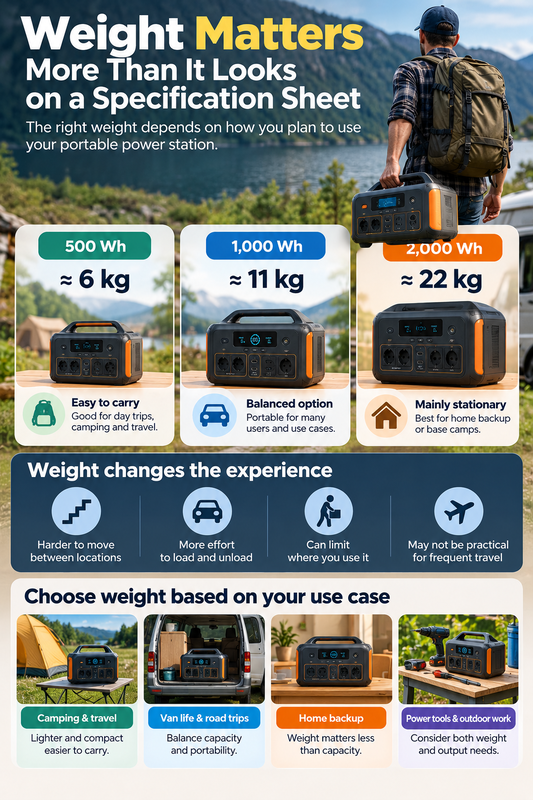
Battery capacity often increases weight.
A station used as fixed home backup can tolerate much more weight than one that must be moved between a car, campsite and house.
Ask:
How often will I actually carry this?
For a stationary system, energy capacity may matter more than portability.
For travel, a slightly smaller station that can be moved easily may be more useful than a much larger model that rarely leaves one location.
This is where energy density becomes a practical rather than purely technical specification.
Ports Should Match the Devices You Actually Use
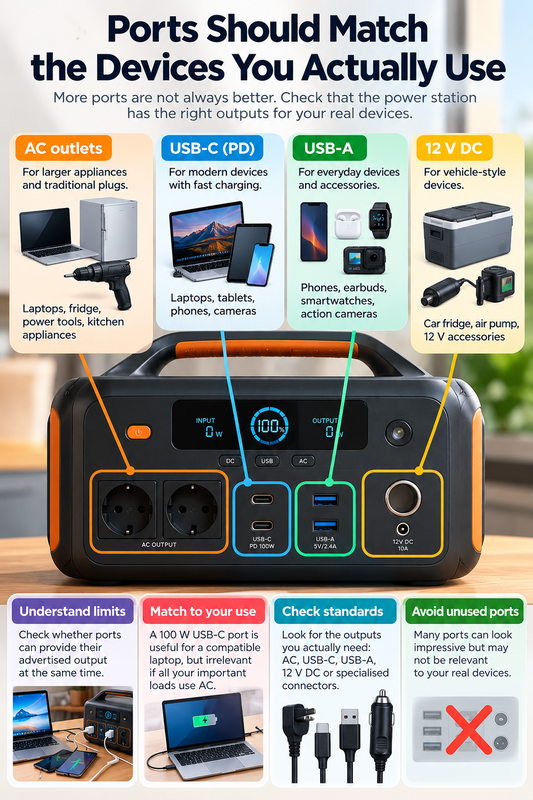
A station with many ports is not automatically more useful.
Check whether it has the right outputs:
AC outlets;
USB-A;
USB-C Power Delivery;
12 V DC;
regulated vehicle-style outputs;
specialist connectors if required.
Also check whether those ports can provide their advertised output simultaneously.
A 100 W USB-C port is valuable for a compatible laptop but irrelevant if all your important loads use AC.
Do Not Compare Every Specification With One Score
Portable power stations combine several different capabilities.
A useful comparison separates them:
Energy: Wh and realistic usable energy.
Power: continuous and surge output.
Longevity: chemistry, cycle life and warranty.
Recharge: AC, solar and vehicle charging.
Portability: weight and dimensions.
Scalability: expansion batteries and system limits.
Connectivity: ports and output standards.
Trying to collapse all of these into a single “best power station” score usually hides the trade-offs.
A better comparison asks which combination fits the intended job.
Compare Around the Use Case
For occasional phone, laptop and lighting backup, a smaller station may be sufficient.
For refrigeration, pumps or power tools, inverter output and surge performance become more important.
For multi-day outages, total Wh, recharge options and expandability matter more.
For frequent daily use, cycle life becomes much more significant.
For travel, weight and physical size may become decisive.
That is why buying guides are more useful when they explain decision criteria rather than simply ranking products.
A broader framework for comparing battery specifications without mixing incompatible metrics is available here:
https://medium.com/@wwwebadvisor/how-to-compare-battery-specifications-without-comparing-the-wrong-numbers-465866390d58
A Practical Comparison Order
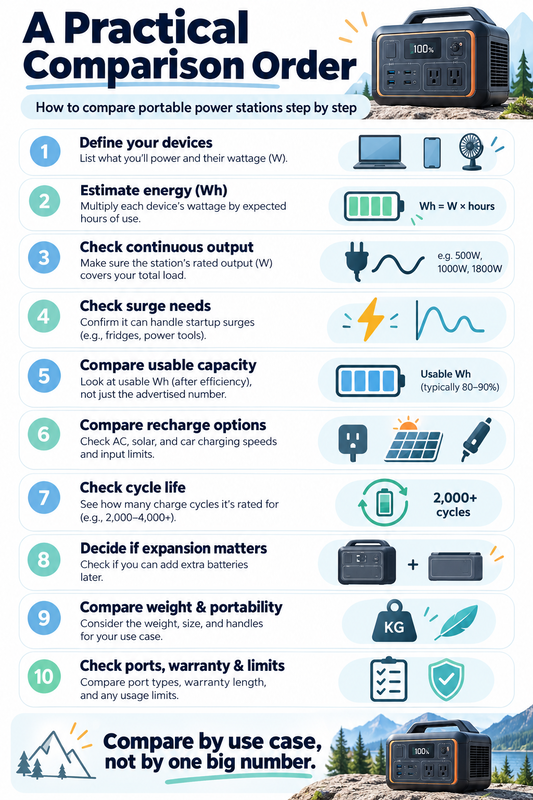
When comparing two portable power stations, use this sequence:
Define the devices you need to power.
Estimate the energy requirement in Wh.
Check continuous output.
Check surge requirements where relevant.
Compare realistic usable capacity.
Compare recharge options and charging speed.
Check cycle life and chemistry.
Decide whether expansion matters.
Compare weight and portability.
Check ports, warranty and practical system limits.
Only after those questions are answered does price become meaningful.
The Practical Rule
Do not choose a portable power station because one specification looks impressive.
Wh tells you how much energy is stored.
Continuous W tells you how much load it can support.
Surge W helps determine whether high-startup loads can begin operating.
Cycle life tells you something about long-term use.
Charging specifications tell you how quickly that stored energy can be restored.
Weight and expandability determine how practical the system is over time.
The best portable power station is therefore not the one with the largest number on the box. It is the one whose capacity, output, charging and physical design fit the actual job.
Comments
No comments yet. Be the first to comment!