How Much Battery Reserve Margin Do You Need?
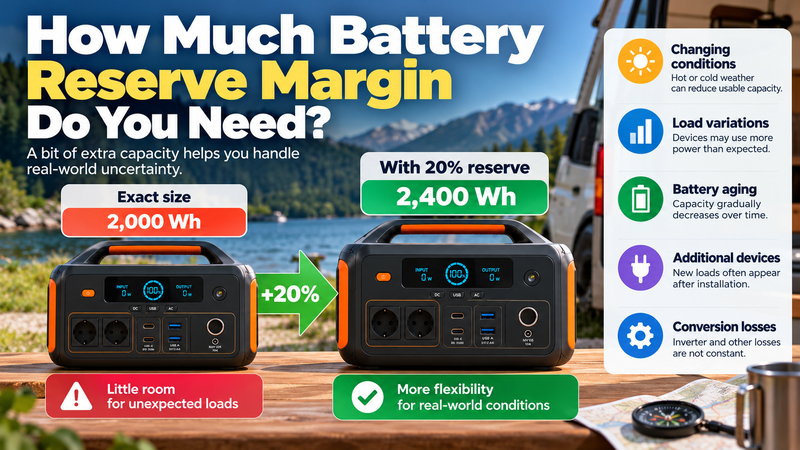
Sizing a battery exactly to the calculated load may look efficient, but it leaves little room for real-world uncertainty. Energy consumption changes, conversion losses vary, batteries age, temperatures affect performance, and additional devices often appear after the original calculation.
That is why practical battery sizing usually includes a reserve margin: extra capacity beyond the calculated minimum.
The goal is not to choose the largest battery possible. It is to create enough buffer that small errors or changing conditions do not immediately turn into a power shortage.
For the broader battery-capacity framework:
https://medium.com/@volodymyrzh/battery-capacity-explained-mah-wh-amp-hours-decoded-1dc676be5a38
What Is a Battery Reserve Margin?
A reserve margin is the difference between your calculated energy requirement and the battery capacity you actually choose.
Suppose your estimated usable-energy requirement is:
2,000 Wh
If you design the system around exactly 2,000 Wh of available energy, the calculation assumes your estimate is almost perfect.
If instead you plan for:
2,400 Wh
you have added:
400 Wh of reserve
or:
20% above the calculated requirement
That reserve can absorb differences between the model and real use.
Reserve Is Not the Same as Usable Capacity
Before adding reserve, distinguish nominal battery capacity from usable capacity.
A battery rated at 2,000 Wh may not provide the full 2,000 Wh to connected loads because of:
inverter losses;
internal electronics;
battery-management limits;
temperature;
standby consumption;
system-specific discharge limits.
Reserve should therefore be applied to a realistic energy requirement rather than used to hide an incorrect assumption about usable capacity.
For the underlying distinction:
https://digitalowl.fika.bar/rated-capacity-vs-usable-capacity-what-s-the-difference-01M2GQ5Y5KA68T9JHJQKWPD6TE
Start With the Calculated Load
The first step is still to estimate what the battery must actually support.
If your essential devices consume:
800 Wh for refrigeration;
400 Wh for internet and communication;
300 Wh for lighting;
500 Wh for computers and devices;
the total is:
2,000 Wh
That is the base requirement before reserve.
For home-backup planning:
https://digitalowl.fika.bar/how-much-battery-capacity-do-you-need-for-home-backup-01M41CTYZGP56F26YBTXNACTW5
Why Exact Sizing Is Fragile
Energy calculations contain assumptions.
A refrigerator may run more frequently during hot weather. A laptop may draw more power under heavy workloads. A pump may cycle more often than expected. Someone may connect another device during an outage.
Even relatively small differences can accumulate.
If the calculated requirement is exactly 2,000 Wh and the real load becomes 2,150 Wh, a system with no reserve is already undersized.
Reserve creates tolerance for these normal variations.
Conversion Efficiency Is Not Constant
A battery system does not operate at exactly the same efficiency under every load.
Inverter efficiency can change with output power. Very small loads may be affected more by standby consumption. High loads can increase heat and conversion losses.
A calculation based on one assumed efficiency should therefore not be treated as an exact prediction.
This does not mean adding an arbitrary huge battery.
It means recognising that a model containing assumptions should have some margin around it.
Battery Aging Changes Available Capacity
A new battery and the same battery several years later may not provide the same usable energy.
Battery capacity gradually declines with use and time.
If a backup system is designed with zero reserve when new, degradation can eventually push it below the original energy requirement.
A moderate reserve can therefore serve two roles:
short-term uncertainty and long-term capacity loss.
How important this is depends on how frequently the battery is cycled, its chemistry, operating conditions and expected service life.
Temperature Can Reduce Practical Margin
Cold or hot conditions can affect battery behaviour.
If a system will operate in a controlled indoor environment, temperature uncertainty may be relatively small.
If it will operate in a vehicle, workshop, garage, outdoor enclosure or other variable environment, temperature becomes a more important planning factor.
The useful question is not:
“How much capacity does the battery have under ideal conditions?”
It is:
“How much usable energy can I reasonably expect under the conditions in which I will actually use it?”
Unexpected Loads Are Often the Biggest Source of Error
Many systems grow after installation.
A backup setup originally intended for:
router;
lights;
phones;
may later also support:laptop;
television;
fan;
additional networking equipment.
The battery did not become smaller. The load became larger.
A reserve margin gives the system some ability to absorb small additions without requiring immediate expansion.
How Much Reserve Should You Add?
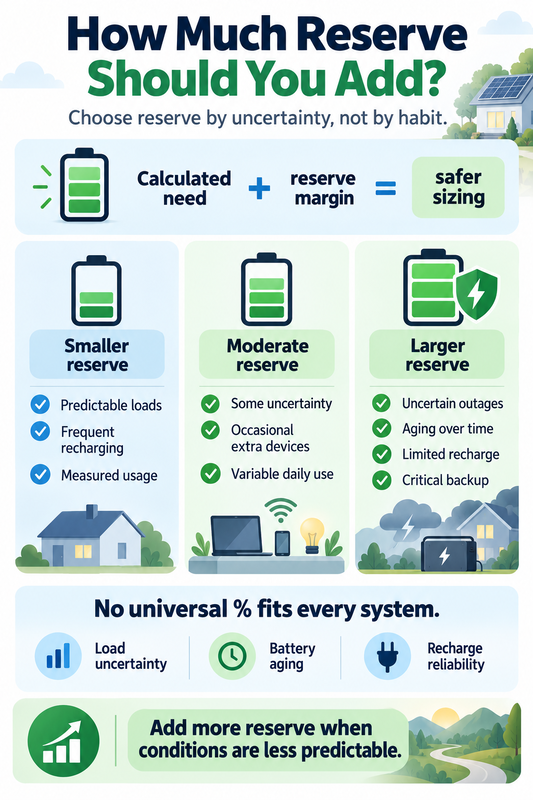
There is no universal percentage that is correct for every battery system.
A useful reserve depends on uncertainty.
A relatively predictable load with regular recharging may need less buffer than an emergency system expected to operate through unpredictable outages.
Instead of treating reserve as one fixed rule, think in ranges.
A small reserve may make sense when:
loads are measured accurately;
runtime is predictable;
recharging is frequent and reliable;
expansion is easy.
A larger reserve may make sense when:load estimates are uncertain;
outage duration varies;
the system is safety- or continuity-critical;
batteries are expected to remain useful for years;
recharge opportunities are uncertain;
additional loads are likely.
The percentage should follow the uncertainty, not the other way around.
Example: Adding a 20% Reserve
Suppose your realistic energy requirement after efficiency adjustments is:
2,500 Wh
A 20% reserve would be:
2,500 × 0.20 = 500 Wh
Target capacity:
2,500 + 500 = 3,000 Wh
The extra 500 Wh is not expected consumption.
It is protection against estimation error and changing conditions.
If actual demand remains close to 2,500 Wh, the reserve stays unused.
That is precisely what reserve capacity is supposed to do.
Example: Multi-Day Backup
Reserve becomes even more important when the system must operate across several days.
Suppose essential loads consume:
2 kWh per day
For three days without recharge:
2 × 3 = 6 kWh
If actual daily consumption rises by only 10%, the three-day requirement becomes:
6.6 kWh
The absolute difference becomes larger as outage duration increases.
This is one reason multi-day systems need more careful assumptions than short-duration backups.
For the dedicated sizing guide:
https://digitalowl.fika.bar/battery-capacity-for-multi-day-outages-01M43RTN3WEAM6XD3ZRQSFW7F2
Recharge Availability Changes the Reserve Question
A battery that can reliably recharge every day does not need to solve the same problem as a battery that may receive no energy for several days.
If solar, grid availability or another charging source restores much of the daily consumption, reserve can focus on:
cloudy periods;
delayed charging;
unusually high consumption;
temporary interruptions.
Without reliable recharging, the battery itself carries more of the uncertainty.
Reserve sizing should therefore consider both stored energy and replenishment.
Do Not Confuse Reserve With Oversizing
More capacity is not automatically better.
Oversizing can increase:
purchase cost;
physical size;
weight;
charging time;
unused capacity.
The goal is not maximum capacity.
The goal is enough capacity plus a defensible buffer.
A system calculated to need 2 kWh probably does not require 10 kWh merely because extra reserve sounds safer.
Reserve should have a reason.
Reserve Margin Is Part of a Larger Sizing Framework
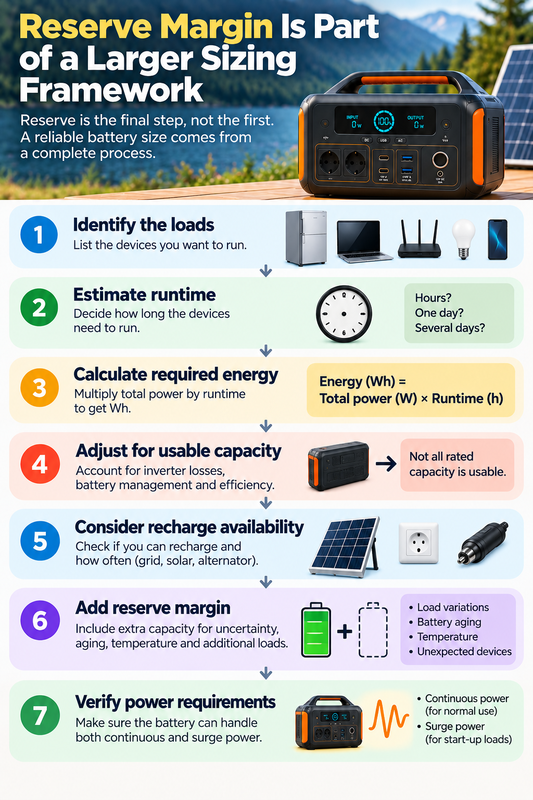
Battery sizing works best as a sequence:
Identify the loads.
Estimate realistic runtime.
Calculate required energy.
Adjust for conversion and usable capacity.
Consider recharge availability.
Add reserve for uncertainty.
Verify continuous and surge power separately.
This is the same logic used in a broader practical backup-capacity framework:
https://www.linkedin.com/pulse/from-energy-loads-backup-capacity-practical-sizing-volodymyr-zhyliaev-ee6qf/
The reserve margin comes near the end of the calculation. It should not replace the earlier steps.
The Practical Rule
First calculate the capacity you realistically expect to need.
Then ask:
How confident am I in that number?
If the loads are measured, predictable and easily recharged, the reserve may be relatively modest.
If the system must survive uncertain outages, variable loads, aging and limited recharging, a larger margin becomes more valuable.
Think of reserve capacity as insurance against imperfect assumptions, not as another load that must always be consumed.
The right battery is therefore not simply the one that matches today's calculated requirement. It is the one that still works when real conditions differ slightly from the spreadsheet.
Comments
No comments yet. Be the first to comment!