How to Convert Ah to Wh: Formula and Examples
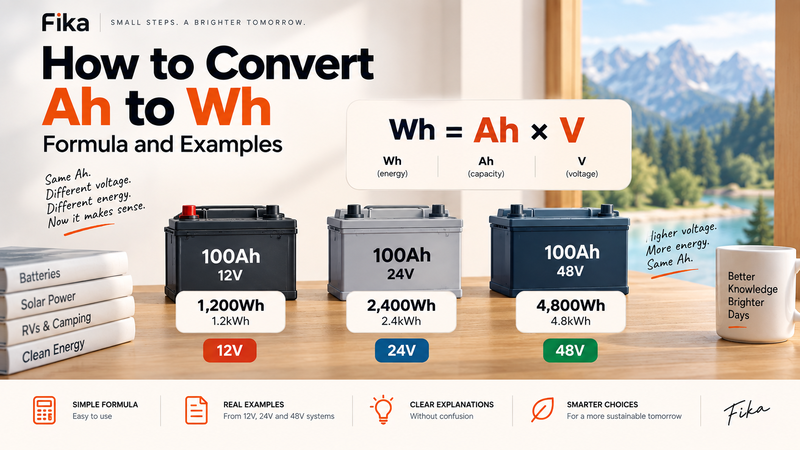
Battery capacity is often listed in amp-hours (Ah), especially for car batteries, RV batteries, solar-storage systems, marine batteries, and larger battery packs.
But Ah alone does not tell you how much energy a battery stores. To calculate energy in watt-hours (Wh), you also need the battery voltage.
The basic formula is:
Wh = Ah × V
For a broader explanation of how Ah, Wh, voltage, and battery capacity fit together, see:
https://medium.com/@volodymyrzh/battery-capacity-explained-mah-wh-amp-hours-decoded-1dc676be5a38
The Ah to Wh Formula
To convert amp-hours to watt-hours, multiply the battery capacity in Ah by its voltage:
Watt-hours (Wh) = Amp-hours (Ah) × Voltage (V)
For example, a battery rated at:
100Ah
12V
has a nominal energy capacity of:
100Ah × 12V = 1,200Wh
So:
100Ah at 12V = 1,200Wh
The calculation itself is simple. The important part is understanding why voltage is necessary.
Why Ah Alone Is Not Enough
Amp-hours measure electrical charge.
A 100Ah battery can theoretically supply 100 amps for one hour, 10 amps for ten hours, or another equivalent combination under idealized conditions.
But Ah does not describe energy by itself.
Two batteries can both be rated at 100Ah while storing very different amounts of energy if their voltages differ.
For a focused explanation of amp-hours:
https://digitalowl.fika.bar/what-is-ah-amp-hours-explained-simply-01M2GGB34443JC68WVPZBGPX3K
100Ah at 12V, 24V, and 48V
The easiest way to see why voltage matters is to compare the same Ah rating at different nominal voltages.
100Ah at 12V
100 × 12 = 1,200Wh
Nominal energy: 1.2kWh
100Ah at 24V
100 × 24 = 2,400Wh
Nominal energy: 2.4kWh
100Ah at 48V
100 × 48 = 4,800Wh
Nominal energy: 4.8kWh
All three batteries are rated at 100Ah, but their energy capacities are very different.
The 48V battery contains four times the nominal energy of the 12V battery at the same Ah rating.
This is why comparing battery sizes by Ah alone can be misleading when system voltages differ.
Which Voltage Should You Use?
For a nominal capacity conversion, use the nominal voltage associated with the battery or battery system.
Do not automatically use whatever voltage you happen to measure at the terminals at a particular moment.
Battery voltage changes during operation.
A battery may show a higher voltage when fully charged, a lower voltage during discharge, and a temporary voltage drop when a heavy load is applied.
Those changing measurements describe the battery's current electrical state. They are not necessarily the correct reference for converting a manufacturer's rated Ah capacity into nominal Wh.
For more on what battery voltage represents:
More Ah to Wh Examples
Here are several practical conversions.
50Ah at 12V
50 × 12 = 600Wh
Result: 600Wh
75Ah at 12V
75 × 12 = 900Wh
Result: 900Wh
100Ah at 12V
100 × 12 = 1,200Wh
Result: 1,200Wh
100Ah at 24V
100 × 24 = 2,400Wh
Result: 2,400Wh
200Ah at 24V
200 × 24 = 4,800Wh
Result: 4,800Wh
100Ah at 48V
100 × 48 = 4,800Wh
Result: 4,800Wh
Notice that a 200Ah 24V system and a 100Ah 48V system both represent approximately 4,800Wh of nominal energy.
Their Ah ratings are different, but their nominal Wh capacity is the same.
Why Wh Is Better for Comparing Different Battery Voltages
Watt-hours combine charge capacity and voltage into a single energy figure.
That makes Wh particularly useful when comparing batteries across 12V, 24V, 36V, 48V, or other electrical systems.
For example:
100Ah at 12V = 1,200Wh
50Ah at 24V = 1,200Wh
The second battery has only half the Ah rating, but the higher voltage means both batteries represent the same nominal energy.
If you looked only at Ah, the 100Ah battery might appear twice as large. Looking at Wh reveals that their nominal stored energy is equivalent.
For a deeper explanation of watt-hours:
https://digitalowl.fika.bar/what-is-a-watt-hour-wh-explained-simply-01M2GM471S7BVV7BQ4R37DEEAP
Does Ah × V Give Exact Usable Energy?
Not always.
The formula gives you the battery's nominal energy capacity based on its stated Ah capacity and nominal voltage.
Actual usable energy can be lower because of factors such as:
battery-management limits;
inverter and conversion losses;
discharge rate;
temperature;
battery age;
manufacturer-defined operating reserves;
device cutoff voltage.
So a 100Ah 12V battery calculated as 1,200Wh does not guarantee that an appliance will receive exactly 1,200Wh.
The formula is still extremely useful because it converts the battery specification into a common energy unit that is easier to compare and use in later runtime calculations.
The Simple Rule
To convert Ah to Wh, use:
Wh = Ah × V
For example:
100Ah × 12V = 1,200Wh
100Ah × 24V = 2,400Wh
100Ah × 48V = 4,800Wh
The Ah rating tells you the amount of electrical charge. Voltage provides the additional information needed to calculate energy.
That is why the same Ah rating can represent very different amounts of stored energy at different voltages.
Comments
No comments yet. Be the first to comment!