How to Convert Wh to kWh: Formula and Examples
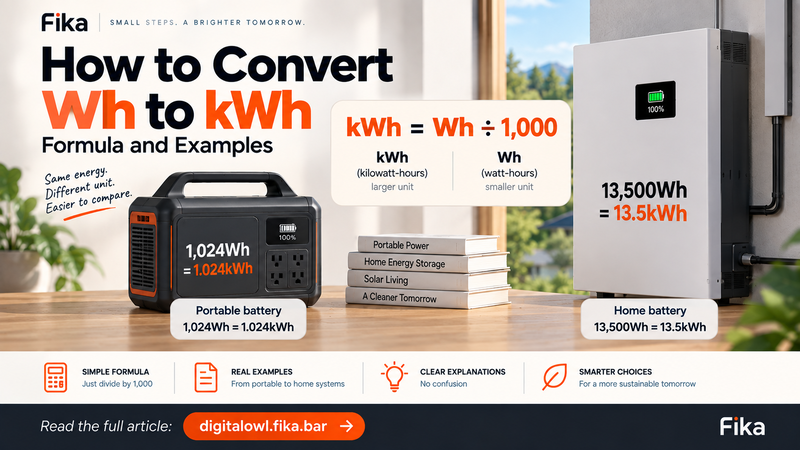
Battery capacity and electricity use are often expressed in either watt-hours (Wh) or kilowatt-hours (kWh). These units measure the same thing — energy — but at different scales.
The conversion is simple:
kWh = Wh ÷ 1,000
So a battery rated at 2,000Wh has a capacity of:
2,000 ÷ 1,000 = 2kWh
For a broader explanation of battery capacity, Wh, Ah, mAh, and related units, see:
https://medium.com/@volodymyrzh/battery-capacity-explained-mah-wh-amp-hours-decoded-1dc676be5a38
The Wh to kWh Formula
To convert watt-hours to kilowatt-hours, divide by 1,000:
Kilowatt-hours (kWh) = Watt-hours (Wh) ÷ 1,000
This works because:
1kWh = 1,000Wh
For example:
500Wh ÷ 1,000 = 0.5kWh
1,000Wh ÷ 1,000 = 1kWh
2,500Wh ÷ 1,000 = 2.5kWh
10,000Wh ÷ 1,000 = 10kWh
Wh and kWh are therefore not different kinds of capacity. They are simply different-sized units for expressing energy.
Why Batteries Often Use Wh
Smaller batteries and portable power stations are commonly rated in Wh because the numbers remain easy to read.
A portable battery might be listed as:
256Wh
512Wh
1,024Wh
2,048Wh
Writing these capacities in kWh would give:
0.256kWh
0.512kWh
1.024kWh
2.048kWh
Both forms are correct. Wh is simply more convenient for many smaller systems.
For a focused explanation of what watt-hours represent, see:
https://digitalowl.fika.bar/what-is-a-watt-hour-wh-explained-simply-01M2GM471S7BVV7BQ4R37DEEAP
Why Larger Systems Often Use kWh
As energy capacity increases, kWh becomes easier to work with.
Consider a home battery with a capacity of 13,500Wh.
In Wh:
13,500Wh
In kWh:
13.5kWh
The second figure is shorter and easier to compare with household electricity consumption, which is also commonly measured in kWh.
This is why home battery systems, electric vehicle batteries, utility bills, and larger energy-storage systems usually use kWh rather than Wh.
Portable Battery Examples
Here are a few common battery sizes expressed in both units.
300Wh
300 ÷ 1,000 = 0.3kWh
So:
300Wh = 0.3kWh
500Wh
500 ÷ 1,000 = 0.5kWh
So:
500Wh = 0.5kWh
1,024Wh
1,024 ÷ 1,000 = 1.024kWh
So:
1,024Wh = 1.024kWh
2,000Wh
2,000 ÷ 1,000 = 2kWh
So:
2,000Wh = 2kWh
These examples show that you do not need a different formula for portable power stations. The same conversion always applies.
Household Battery Examples
The numbers become larger when you move into home backup or stationary energy storage.
5,000Wh
5,000 ÷ 1,000 = 5kWh
10,000Wh
10,000 ÷ 1,000 = 10kWh
13,500Wh
13,500 ÷ 1,000 = 13.5kWh
20,000Wh
20,000 ÷ 1,000 = 20kWh
A 20,000Wh home battery and a 20kWh home battery therefore describe the same nominal energy capacity.
Only the unit has changed.
A Quick Decimal-Shift Method
Because 1kWh equals 1,000Wh, you can think of the conversion as moving the decimal point three places to the left.
For example:
1,000Wh → 1.000kWh
2,500Wh → 2.500kWh
750Wh → 0.750kWh
125Wh → 0.125kWh
This shortcut is useful when you want to convert battery specifications quickly without a calculator.
Just remember that you are still mathematically dividing by 1,000.
Wh and kWh Measure Energy, Not Power
One common source of confusion is mixing up Wh or kWh with W or kW.
Wh and kWh describe energy.
W and kW describe power.
For example, a battery may store:
2kWh of energy
while an appliance may draw:
1kW of power
Those numbers are related when calculating runtime, but they do not mean the same thing.
The Wh-to-kWh conversion itself does not calculate how long a battery will run an appliance. It only changes the unit used to express the stored energy.
Does Converting to kWh Change the Battery Capacity?
No.
A battery rated at:
2,000Wh
and the same battery described as:
2kWh
have exactly the same energy capacity.
Converting between Wh and kWh does not increase, reduce, or otherwise change the battery.
It only changes the scale used to write the number.
This is similar to expressing a distance as 1,000 metres or 1 kilometre. The underlying quantity remains the same.
The Simple Rule
To convert Wh to kWh:
kWh = Wh ÷ 1,000
So:
500Wh = 0.5kWh
1,000Wh = 1kWh
2,000Wh = 2kWh
10,000Wh = 10kWh
Use Wh when smaller battery capacities are easier to read that way. Use kWh when dealing with larger energy-storage systems or household-scale electricity use.
The key point is simple: Wh and kWh measure the same energy quantity — kWh is just the larger unit.
Comments
No comments yet. Be the first to comment!