How to Calculate Energy Consumption in Watt-Hours
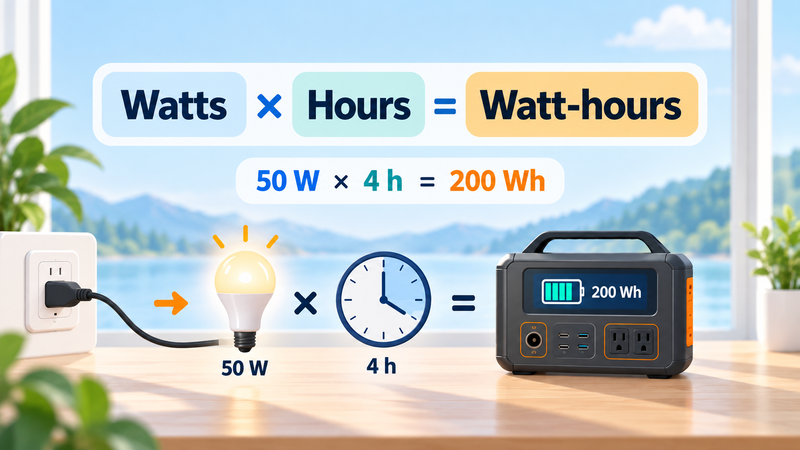
Knowing how many watts a device uses is useful, but watts alone do not tell you how much energy the device will consume. To measure energy use over time, you need watt-hours, usually written as Wh. The calculation is simple once you know the device's power draw and how long it operates.
This distinction matters when comparing batteries, portable power stations, solar systems or everyday electrical devices. If you are still building the broader picture of battery specifications and energy capacity, this battery capacity guide explains how the main units fit together: https://medium.com/@volodymyrzh/battery-capacity-explained-mah-wh-amp-hours-decoded-1dc676be5a38
The Basic Watt-Hour Formula
For a device with a reasonably constant power draw, energy consumption can be calculated with one formula:
Energy consumption (Wh) = Power (W) × Time (hours)
A 50-watt device running for 4 hours therefore consumes:
50 W × 4 h = 200 Wh
The important point is that watts describe the rate at which the device uses energy, while watt-hours describe the total amount of energy used over a period of time. If that difference is still unclear, this explanation of watts vs watt-hours covers it in more detail: https://digitalowl.fika.bar/watts-vs-watt-hours-what-s-the-difference-01M2GNJJ68FM3605JW1JW54A99
Example: Calculating Energy Use for a Constant Load
Imagine a small fan that draws 35 watts while operating. If you run it continuously for 6 hours, its approximate energy consumption is:
35 W × 6 h = 210 Wh
Run the same fan for 10 hours and the result becomes:
35 W × 10 h = 350 Wh
This shows why operating time matters just as much as wattage. A relatively low-power device can still consume a significant amount of energy when it operates for many hours.
The same method works for many simple loads:
10 W LED light for 5 hours = 50 Wh
40 W monitor for 8 hours = 320 Wh
75 W television for 3 hours = 225 Wh
100 W device for 30 minutes = 50 Wh
For periods shorter than one hour, convert minutes into a fraction of an hour first. Thirty minutes is 0.5 hours, 15 minutes is 0.25 hours and 90 minutes is 1.5 hours.
What If the Power Draw Changes?
Many real devices do not consume the same number of watts continuously. A laptop may draw more power while charging or performing demanding work and much less when idle. Refrigerators, pumps and other cycling appliances can switch between high consumption and little or no consumption throughout the day.
In these cases, using the device's maximum wattage for the entire operating period can significantly overestimate its energy use. A more useful approach is to estimate or measure its average power consumption over the period you care about.
Suppose a laptop varies between roughly 20 W and 60 W during normal use, but measurement shows an average draw of about 35 W across a five-hour work session. Its estimated energy consumption would be:
35 W × 5 h = 175 Wh
This average-power method is generally more representative than multiplying the maximum 60 W figure by five hours, which would produce 300 Wh. The quality of the final estimate depends on how accurately the average power represents real operation.
Add Together Devices or Operating Periods
When several devices are involved, calculate the energy used by each device separately and then add the results. This avoids assuming that every device has the same wattage or runs for the same amount of time.
For example, imagine a simple evening setup:
Laptop: 45 W × 4 h = 180 Wh
Monitor: 30 W × 4 h = 120 Wh
LED lamp: 8 W × 5 h = 40 Wh
Total energy consumption:
180 Wh + 120 Wh + 40 Wh = 340 Wh
You can use the same technique when one device operates at different power levels. Calculate each period separately and then add the watt-hours together.
For example:
80 W × 1 h = 80 Wh
30 W × 3 h = 90 Wh
Total:
80 Wh + 90 Wh = 170 Wh
Why Watt-Hours Are More Useful Than Watts for Energy Consumption
Watts tell you how demanding a device is at a particular moment, but watt-hours tell you how much energy it actually uses across time. That makes Wh especially useful when comparing energy consumption with battery capacity, estimating daily electrical demand or recording the energy required by different devices.
A watt-hour is simply a unit of energy equal to one watt used for one hour. For a more detailed explanation of the unit itself and how it relates to batteries, see: https://digitalowl.fika.bar/what-is-a-watt-hour-wh-explained-simply-01M2GM471S7BVV7BQ4R37DEEAP
The most useful rule to remember is therefore:
Watts × hours = watt-hours
When the power draw is constant, multiply the wattage by operating time. When the load changes, use a realistic average power figure or calculate each operating period separately. The result gives you an estimate of the device's energy consumption in Wh without confusing instantaneous power with total energy used.
Comments
No comments yet. Be the first to comment!