Digitalowl
- Home
- Why Beginners Should Build Small Projects Before Learning Everything
- What to Power First During a 72-Hour Blackout
Recent posts
-
What Is Capacity Retention?
Battery capacity retention describes how much of a battery's original capacity remains after ageing, cycling or a defined period of use. If a battery originally provides 1,000 Wh and later provides 850 Wh under comparable test conditions, its capacity retention is approximately 85%. This sounds simple, but capacity-retention figures are often misunderstood. A specification such as “80% capacity af…

- batteries
- electricity
- +3
-
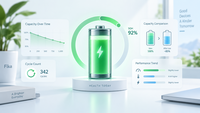
What Is Battery State of Health?
Battery State of Health, usually shortened to SoH, is an estimate of how a battery's present condition compares with its condition when it was new. A new battery is generally treated as being close to 100% SoH. As the battery ages, repeated cycling, time, temperature and operating conditions can reduce its ability to perform as originally specified. SoH attempts to describe that change in a compac…
- batteries
- electricity
- +2
-
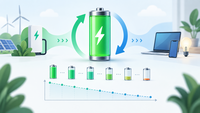
What Is Battery Cycle Life?
Battery cycle life tells you roughly how many charge-and-discharge cycles a battery can complete before its ability to store energy falls to a specified level. It is one of the most useful battery longevity specifications, but it is also easy to misunderstand. A battery rated for 2,000 cycles does not normally work perfectly for cycle 1,999 and suddenly fail at cycle 2,000. Capacity usually declin…
- batteries
- electricity
- +2
-
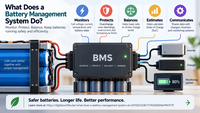
What Does a Battery Management System Do?
A battery management system, or BMS, is the electronic control system that monitors and helps protect a rechargeable battery pack. It does not create extra battery capacity, and it cannot make every unsafe situation harmless. Instead, a BMS watches important operating conditions and can take action when the battery approaches limits defined by the pack design. This makes it one of the key systems …
- batteries
- blackout
- +2
-
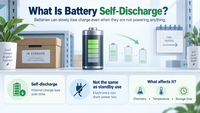
What Is Battery Self-Discharge?
A battery can lose charge even when nothing appears to be using it. Leave a charged battery unused for weeks or months, then check it again, and its state of charge may be lower. Part of that loss can come from electronics connected to the battery, but another part can occur inside the cells themselves. That internal loss is called self-discharge. Self-discharge is the gradual loss of stored charg…
- batteries
- blackout
- +4