Digitalowl
- Home
- Why Beginners Should Build Small Projects Before Learning Everything
- What to Power First During a 72-Hour Blackout
Recent posts
-
How to Prevent Tone Corrections Before the First Draft
Tone corrections often look like a normal part of editing. An editor changes a confident sentence into a cautious one, removes promotional language from a paragraph, asks the writer to sound more conversational or rewrites an introduction because it does not feel like the brand. Each individual correction may seem small, but repeated across an article they can become a substantial second round of …
- branding
- content
- +2
-
How Brand Voice Criteria Make Content Review Less Subjective
Content review often becomes subjective long before anyone describes it that way. An editor leaves a comment saying a paragraph feels too formal. A marketing manager thinks the same paragraph sounds appropriately professional. A founder wants stronger language. A subject expert asks for more qualification. None of these reactions is necessarily wrong, but when the team has no shared criteria for e…
- branding
- content
- +6
-
Why Writers Need Decision Rules Before They Start Drafting
Good writers make hundreds of small decisions while creating even a relatively simple article. They decide how much context the reader needs, which terminology is appropriate, how directly to make a recommendation, when to explain a limitation, how strongly to phrase a claim and whether a paragraph sounds too formal or too promotional. Most of these decisions happen quickly, but together they dete…
- branding
- content
- +5
-
How Small Content Mistakes Create Expensive Revision Cycles
A content revision cycle does not always begin with a dramatic mistake. More often, it starts with something that looks too small to worry about: an unclear phrase in the brief, a missing audience detail, an undefined tone instruction, an assumption about terminology, or a benefit that nobody has fully approved. The first draft may still look good. The problem appears when different people interpr…
- branding
- content
- +5
-
Website Friction: The Hidden Problems That Stop Visitors From Converting
Getting more traffic does not automatically mean getting more customers. A website can attract people through search, social media, referrals, paid campaigns, or content marketing and still produce disappointing results because something gets in the way after visitors arrive. That “something” is often website friction. Friction is any unnecessary difficulty, uncertainty, delay, or extra decision t…
- branding
- content
- +6
-
Why Cart Performance Matters Before Payment
The shopping cart is often treated as a simple bridge between a product page and checkout. A customer has already chosen something, so it can seem as though the difficult part of the conversion journey is over. In reality, the cart is one of the most sensitive stages in an ecommerce funnel because it is where browsing turns into a much more deliberate purchase decision. A slow or unpredictable car…
- coding
- content
- +8
-
The Conversion Cost of Slow Website Experience
Slow website performance is often treated as a technical inconvenience: a page takes a little longer to load, a button reacts slowly, or checkout needs a few extra seconds to process. From a business perspective, however, the more important question is what those delays cost when they appear repeatedly across the customer journey. A single slow interaction may have little measurable effect. The pr…
- content
- conversion-rate-optimization
- +7
-
Why Fast Pages Help Users Make Decisions
Website speed is usually discussed as a technical metric, but visitors experience it as part of the decision-making process. Every page load, filter change, product interaction and form step either helps people continue naturally or introduces another moment of hesitation. A fast website does not persuade someone to buy by itself, but it removes unnecessary delays between a visitor deciding what t…
- content
- digital-marketing
- +5
-
How Website Performance Protects Funnel Momentum
A conversion funnel depends on momentum. A visitor arrives with a certain level of interest, learns enough to continue, moves to another page and gradually gets closer to a decision. Every successful step makes the next one easier because the visitor already has context and a reason to keep going. Website performance supports that movement in a way that is easy to overlook until something becomes …
- branding
- content
- +8
-
How Hosting Limits Reduce the Value of Content Marketing
Businesses spend time and money researching topics, writing articles, creating guides, producing videos, designing landing pages and building search visibility. The goal is to attract relevant visitors and move them towards a useful action. However, publishing strong content does not guarantee that visitors will receive a strong experience. If the hosting environment responds slowly, struggles dur…
- content
- conversion-rate-optimization
- +9
-
Why Website Owners Should Review Hosting Before a Campaign
A marketing campaign is designed to bring more people to a website. Paid advertising, email promotions, social media posts, influencer mentions and seasonal offers can all create a sudden increase in traffic. Most campaign preparation focuses on the visible elements: the offer; advertising creative; landing-page copy; audience targeting; email sequences; tracking and analytics. Hosting is o…
- content
- digital-marketing
- +4
-
Why WooCommerce Stores Need Stable Hosting During Promotions
Promotions are designed to create more activity in a short period. A discount code, seasonal sale, product launch or email campaign can send many customers to a WooCommerce store within minutes. That increased attention is valuable, but it also changes the technical workload. Customers do not simply open a page and leave. They search the catalogue, view products, select variations, add items to ba…
- content
- digital-marketing
- +8
-
How Slow Pages Reduce the Value of Paid Traffic
Paid advertising can bring visitors to a website quickly. A campaign may target the right audience, use a strong message, and generate a steady flow of clicks. However, a click is not the final result. The visitor still needs to wait for the landing page, understand the offer, trust the website, and complete the next action. When pages are slow, part of the advertising budget is spent on visitors …
- content
- digital-marketing
- +5
-
Why Conversion Problems Are Not Always Marketing Problems
The business may change the advert, rewrite the headline, adjust the offer, or target a different audience. These changes can help, but they do not solve every conversion problem. Sometimes the campaign brings the right people to the right page. The problem begins after they arrive. A slow, unstable, or difficult website can reduce conversions even when the marketing strategy is working. Good Traf…
- branding
- content
- +5
-
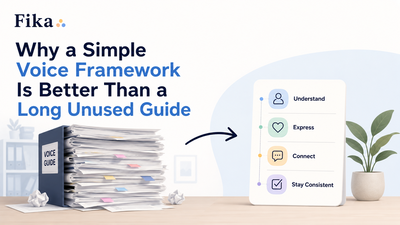
Why a Simple Voice Framework Is Better Than a Long Unused Guide
A brand voice guide can look impressive and still fail in daily content work. It may include a mission statement, personality traits, audience notes, tone adjectives, positioning language, and examples from different channels. On paper, this feels complete. But when a writer, marketer, or editor opens it during real production, the question is much simpler: what should I actually do with this para…
- branding
- coding
- +7
-
Why Voice Rules Should Be Easy to Use While Writing
Brand voice rules are only useful if writers can apply them during real content work. A voice document may look polished, include thoughtful descriptions, tone traits, examples, and strategic notes, but still fail in daily use. If the rules are too abstract, too long, or too hard to apply while writing, they will not guide actual decisions. Writers will still guess how direct a headline should be.…

- content
- conversion-rate-optimization-cro
- +3
-
What to Include in a Practical Brand Voice Document
A brand voice document should not be a decorative file that people open once and forget. It should help writers, editors, marketers, founders, and content reviewers make better decisions when they create real content. That is why a practical brand voice document needs more than a short description of the brand personality. It should explain how the voice works, what it changes in writing, what the…

- branding
- content
- +5