Why Voice Rules Should Be Easy to Use While Writing
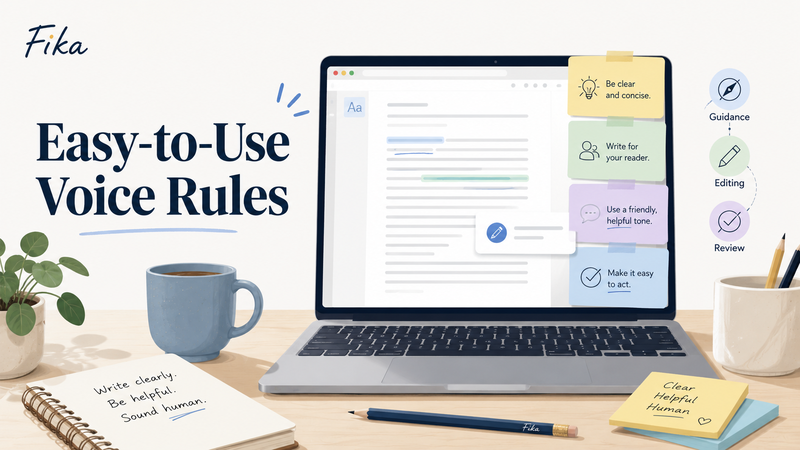
Brand voice rules are only useful if writers can apply them during real content work. A voice document may look polished, include thoughtful descriptions, tone traits, examples, and strategic notes, but still fail in daily use. If the rules are too abstract, too long, or too hard to apply while writing, they will not guide actual decisions.
Writers will still guess how direct a headline should be. Editors will still leave vague feedback. AI drafts will still need heavy rewriting. Freelancers will still ask for clarification. That is why good voice rules should not only sound correct. They should help someone write a better headline, introduction, landing page section, email, product description, or call to action.
A practical brand voice document turns voice from a general idea into a working tool.
Writers need rules they can apply quickly
Most writing decisions happen in small moments. A writer may need to decide whether a sentence should be more direct, whether a CTA should sound urgent or calm, whether a paragraph needs more context, or whether a benefit should be more specific.
If the voice rule is too vague, it will not help with these decisions. For example, a rule like “sound human and helpful” may be true, but it is not enough. It does not tell the writer what to change in the sentence.
A more useful rule would be:
“Use direct language, explain the next step clearly, and avoid adding casual phrases that do not make the message more helpful.”
This kind of rule is easier to apply because it points to actual writing behavior. It helps the writer understand what to do, what to avoid, and how the voice should appear in real content.
Practical rules reduce guessing
When voice rules are difficult to use, every writer creates their own interpretation. One writer may make the content more casual. Another may make it more formal. Another may add stronger claims. Another may simplify the message so much that it loses meaning.
This creates inconsistency even when everyone is trying to follow the same brand voice. Easy-to-use rules reduce that guessing because they give the team a shared standard.
A practical voice rule should help writers understand:
what the voice should do;
what the voice should avoid;
how the tone changes by content type;
what a good version looks like;
how to review a draft before sending it forward.
This is why a practical brand voice document should include not only traits, but also examples, boundaries, and review criteria. The previous Fika article covers the core parts to include in that kind of document: https://digitalowl.fika.bar/what-to-include-in-a-practical-brand-voice-document-01KWQ4S2WQKMYAGHCKB5K9A3EM
Rules should be connected to content situations
A voice rule becomes more useful when it is connected to real content. For example, “be clear” can mean different things depending on where the content appears.
On a landing page, clarity may mean explaining the offer quickly and showing why it matters. In a support reply, clarity may mean giving the answer before extra context. In an onboarding email, clarity may mean showing the next step and reducing uncertainty. In a blog post, clarity may mean organizing the explanation so the reader can follow the argument.
If the rule does not mention context, the writer may apply it too broadly or too mechanically. A practical rule should help the writer understand where and how to use it.
For example:
“On product pages, explain the benefit before adding secondary details. In support content, answer the direct question first, then add context only if it helps the reader act.”
This is much more useful than a general instruction to “write clearly.” It gives the writer a decision rule, not just a tone label.
Easy rules are better for editing too
Voice rules are not only for writers. They also help editors and reviewers. Without practical rules, feedback often becomes subjective.
Common vague feedback includes:
“Make it more on-brand.”
“This does not sound right.”
“Can we make it more human?”
“This feels too generic.”
“Make it warmer.”
The writer may understand that something needs to change, but not what exactly to fix. Clear rules make feedback more specific and easier to act on.
Instead of saying “make it more confident,” an editor can say:
“The claim is strong, but it needs a reason or example. Add support so the confidence feels grounded.”
Instead of saying “make it more friendly,” the editor can say:
“The message is clear, but it feels too cold. Add a short reassurance before the next step.”
This makes the review process faster and less personal. The discussion becomes less about taste and more about agreed writing standards.
Simple rules help with AI-generated drafts
Easy-to-use voice rules are especially useful when working with AI content. AI tools can produce clean drafts quickly, but those drafts often sound generic. They may use broad claims, safe phrasing, repetitive structure, or a tone that feels polished but not specific to the brand.
A practical voice document gives the team a way to check and improve those drafts. Instead of rewriting everything based on instinct, the reviewer can compare the draft with clear voice rules.
Useful review questions include:
Does this draft use our level of directness?
Are the claims specific enough?
Does the tone fit the reader’s situation?
Does the content avoid phrases we do not use?
Does the CTA match our usual approach?
Does this sound like our brand or like a generic template?
This is where structured templates can help turn brand thinking into rules people can actually apply. A full use case for building practical brand voice documents with a template pack is explained here: https://medium.com/@wwwebadvisor/how-to-use-a-tone-of-voice-template-pack-to-build-practical-brand-voice-documents-15a574a609c8
Rules should be short enough to remember
A useful rule does not need to explain everything at once. If a rule is too long, writers may ignore it. If it is too abstract, they may misunderstand it. If it is too strict, the content may become rigid.
The best rules are usually simple enough to remember, but specific enough to guide action.
For example:
Be specific before being persuasive.
Explain the next step before adding extra detail.
Use confidence with proof, not hype.
Make the reader feel guided, not pushed.
Keep friendly language useful, not decorative.
These rules are short, but they still shape writing decisions. They are easy to repeat, easy to apply, and easy to use during review.
Final thought
Voice rules should not be written only for brand documents. They should be written for real writing situations. If writers cannot use the rule while drafting, editing, reviewing, or improving AI content, the rule is probably too abstract.
A practical voice rule should help someone make a better sentence, a clearer paragraph, a stronger CTA, or a more consistent page. The easier the rules are to use, the more likely the brand voice will appear consistently across real content.
Comments
No comments yet. Be the first to comment!