Why a Simple Voice Framework Is Better Than a Long Unused Guide
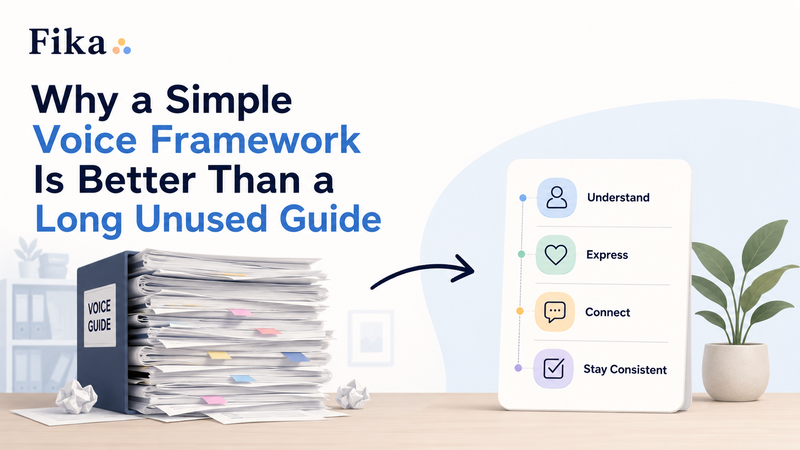
A brand voice guide can look impressive and still fail in daily content work.
It may include a mission statement, personality traits, audience notes, tone adjectives, positioning language, and examples from different channels. On paper, this feels complete. But when a writer, marketer, or editor opens it during real production, the question is much simpler: what should I actually do with this paragraph?
That is where many long brand voice documents lose their value. They explain the brand, but they do not help people make faster writing decisions.
A simple voice framework is different. It does not try to describe everything about the brand. It gives the team a small set of practical rules they can use while drafting, reviewing, and editing content.
Long guides often become reference documents, not working tools
There is nothing wrong with a detailed brand voice guide. Bigger teams may need one, especially when many departments create content. The problem appears when the guide becomes too heavy for everyday use.
A long guide often fails because:
writers do not know which parts matter most;
editors interpret the same tone notes differently;
AI prompts become vague because the source document is too broad;
reviewers give feedback based on preference instead of shared criteria;
new team members skim the document once and then forget it.
The result is not always bad content. The result is inconsistent content. One article sounds sharp and practical. Another sounds soft and generic. A landing page feels confident, while an email feels overly casual. The brand has a guide, but the guide is not shaping decisions.
This is why teams often need a usable framework before they need more documentation.
A simple framework turns voice into choices
A practical voice framework answers a few repeatable questions:
Should this content sound more direct or more explanatory?
Where should the tone be firm, and where should it be supportive?
What words should the team avoid because they weaken trust?
What kind of examples make the brand sound useful?
How should feedback be given when something feels “off”?
These questions are easier to apply than a long list of traits. They help the team move from abstract voice language to real writing behavior.
For example, “helpful” is not enough as a rule. Almost every brand wants to sound helpful. A stronger rule would be:
Do not only say what the user should do. Explain why the step matters and what problem it prevents.
That rule can shape a blog post, checklist, onboarding email, support answer, or AI prompt. It is simple, but it changes the actual content.
This is the same idea behind turning brand voice notes into repeatable content decisions. The previous Fika article covered that process in more detail:
https://digitalowl.fika.bar/how-teams-turn-brand-voice-notes-into-repeatable-content-dec-01KWQ7JMSBDDCV8N5Q3S59D5KJ
Simple does not mean shallow
A simple framework is not a weaker version of a brand voice guide. It is the operational layer that makes the guide usable.
The best frameworks are simple because they force prioritization. They separate what the team truly needs during content creation from what only belongs in background brand documentation.
A useful framework may include:
3–5 voice principles;
short “do / avoid” rules;
examples of weak vs stronger phrasing;
review questions for editors;
channel-specific notes only where needed.
That is enough to reduce confusion without overwhelming the writer.
The goal is not to remove nuance. The goal is to make nuance easier to apply.
Why this matters for content teams
Content teams rarely struggle because they have no opinion about tone. They struggle because tone decisions are scattered.
One reviewer says the copy should be warmer. Another says it should sound more expert. A writer tries to make it more conversational, but the page starts to feel less credible. Then the team spends time correcting symptoms instead of fixing the decision system.
A simple framework gives everyone the same reference point. It helps the team ask better questions:
Is the tone wrong, or is the message unclear?
Is this sentence too casual, or just too vague?
Does the content need more personality, or more proof?
Are we editing for brand fit, or personal preference?
This is especially useful when building practical brand voice documents from templates. A template pack works best when it helps teams move from broad brand thinking into usable writing and review rules. This use case explains the process more directly:
https://medium.com/@wwwebadvisor/how-to-use-a-tone-of-voice-template-pack-to-build-practical-brand-voice-documents-15a574a609c8
A simple framework is easier to reuse
The real test of a voice framework is not whether it sounds smart. The real test is whether people reuse it.
A simple framework can be used in:
blog outlines;
landing page drafts;
AI prompt instructions;
freelancer briefs;
content review checklists;
onboarding notes for new writers;
rewrite requests for old pages.
That is why simplicity is valuable. It lowers the effort required to keep voice consistent.
A long guide may explain the brand once. A simple framework helps the brand show up consistently across many small decisions.
How to know your voice framework is simple enough
A voice framework is probably too complex if people need to reread several pages before editing one paragraph.
It is simple enough when a writer can use it during production, not only before production.
A good test is this: give the framework to someone reviewing a draft and ask them to mark three places where the voice does not match. If they can explain the problem clearly and suggest a better direction, the framework is working. If they only say “make it more on-brand,” the framework is still too vague.
For a broader explanation of how tone of voice works in marketing content, this guide gives the main strategic context:
https://volodymyrzh.medium.com/tone-of-voice-in-marketing-content-9f702ee8de3c
The practical takeaway
A long brand voice guide can be useful. But it should not be the only tool your team depends on.
If people are writing, reviewing, rewriting, prompting AI, or briefing freelancers, they need something more practical: a simple voice framework that turns brand voice into repeatable choices.
The best framework is not the one with the most pages. It is the one your team actually uses when content decisions need to be made.
Comments
No comments yet. Be the first to comment!