Digitalowl
- Home
- Why Beginners Should Build Small Projects Before Learning Everything
- What to Power First During a 72-Hour Blackout
Recent posts
-
How Brand Voice Criteria Make Content Review Less Subjective
Content review often becomes subjective long before anyone describes it that way. An editor leaves a comment saying a paragraph feels too formal. A marketing manager thinks the same paragraph sounds appropriately professional. A founder wants stronger language. A subject expert asks for more qualification. None of these reactions is necessarily wrong, but when the team has no shared criteria for e…
- branding
- content
- +6
-
Why Writers Need Decision Rules Before They Start Drafting
Good writers make hundreds of small decisions while creating even a relatively simple article. They decide how much context the reader needs, which terminology is appropriate, how directly to make a recommendation, when to explain a limitation, how strongly to phrase a claim and whether a paragraph sounds too formal or too promotional. Most of these decisions happen quickly, but together they dete…
- branding
- content
- +5
-
Why Content Briefs Need Voice Rules Before Drafting Starts
A content brief can explain the topic, audience, keywords, structure and call to action while still leaving one of the most important questions unanswered: what should the finished piece actually sound like? When voice is missing from the brief, writers have to make that decision themselves. Sometimes they make a reasonable choice. Sometimes an editor interprets the brand differently. A marketing …
- branding
- content-marketing
- +4
-
How Small Content Mistakes Create Expensive Revision Cycles
A content revision cycle does not always begin with a dramatic mistake. More often, it starts with something that looks too small to worry about: an unclear phrase in the brief, a missing audience detail, an undefined tone instruction, an assumption about terminology, or a benefit that nobody has fully approved. The first draft may still look good. The problem appears when different people interpr…
- branding
- content
- +5
-
Website Friction: The Hidden Problems That Stop Visitors From Converting
Getting more traffic does not automatically mean getting more customers. A website can attract people through search, social media, referrals, paid campaigns, or content marketing and still produce disappointing results because something gets in the way after visitors arrive. That “something” is often website friction. Friction is any unnecessary difficulty, uncertainty, delay, or extra decision t…
- branding
- content
- +6
-
How Website Performance Protects Funnel Momentum
A conversion funnel depends on momentum. A visitor arrives with a certain level of interest, learns enough to continue, moves to another page and gradually gets closer to a decision. Every successful step makes the next one easier because the visitor already has context and a reason to keep going. Website performance supports that movement in a way that is easy to overlook until something becomes …
- branding
- content
- +8
-
The Business Risk Behind Slow Website Infrastructure
A page takes longer to load, the WordPress dashboard occasionally becomes unresponsive or a form needs several seconds to submit. These issues may seem minor because the website remains online. For a business, however, infrastructure performance affects much more than page speed. It can influence customer trust, marketing efficiency, employee productivity, sales reliability and the ability to grow…
- branding
- cro
- +6
-
Why Conversion Problems Are Not Always Marketing Problems
The business may change the advert, rewrite the headline, adjust the offer, or target a different audience. These changes can help, but they do not solve every conversion problem. Sometimes the campaign brings the right people to the right page. The problem begins after they arrive. A slow, unstable, or difficult website can reduce conversions even when the marketing strategy is working. Good Traf…
- branding
- content
- +5
-
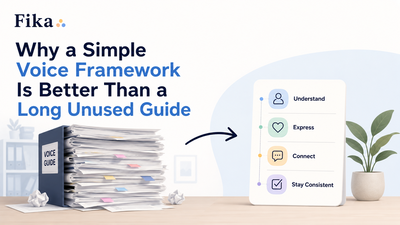
Why a Simple Voice Framework Is Better Than a Long Unused Guide
A brand voice guide can look impressive and still fail in daily content work. It may include a mission statement, personality traits, audience notes, tone adjectives, positioning language, and examples from different channels. On paper, this feels complete. But when a writer, marketer, or editor opens it during real production, the question is much simpler: what should I actually do with this para…
- branding
- coding
- +7
-
What to Include in a Practical Brand Voice Document
A brand voice document should not be a decorative file that people open once and forget. It should help writers, editors, marketers, founders, and content reviewers make better decisions when they create real content. That is why a practical brand voice document needs more than a short description of the brand personality. It should explain how the voice works, what it changes in writing, what the…

- branding
- content
- +5
-
How a Template Pack Turns Voice Ideas Into Writing Rules
They know the brand should sound clear, helpful, expert, friendly, confident, or human. They may have a few notes from strategy work, a short brand deck, a messaging document, or examples of content they like. But when someone needs to write a landing page, edit an email, review an AI draft, or brief a freelancer, those ideas are often too loose to guide the actual work. This is where a template p…

- branding
- content
- +8
-
Why Brand Voice Documents Need More Than Tone Adjectives
Friendly. Professional. Clear. Confident. Human. Helpful. Expert. These words are not useless. They can describe the general direction of a brand voice. But they are not enough to guide real writing. A writer cannot always turn “friendly” into a better landing page section. An editor cannot always use “professional” as a clear review standard. A content team cannot rely on “human” when deciding ho…

- branding
- cro
- +3