Why Brand Voice Documents Need More Than Tone Adjectives
Many brand voice documents start with a short list of adjectives.
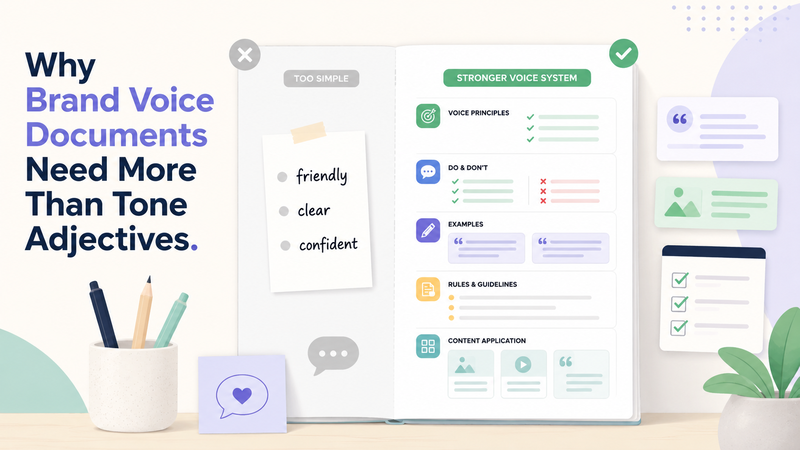
Friendly. Professional. Clear. Confident. Human. Helpful. Expert.
These words are not useless. They can describe the general direction of a brand voice. But they are not enough to guide real writing. A writer cannot always turn “friendly” into a better landing page section. An editor cannot always use “professional” as a clear review standard. A content team cannot rely on “human” when deciding how direct, detailed, warm, cautious, or persuasive a message should be.
A practical brand voice document needs more than tone adjectives. It needs rules that help people make content decisions.
Tone adjectives describe direction, not behavior
Adjectives are easy to agree with because they sound positive. Most brands want to sound clear, useful, trustworthy, and human. The problem appears later, when different people interpret those words differently.
For one writer, “friendly” may mean warm and simple. For another, it may mean casual and playful. For one editor, “confident” may mean direct and specific. For another, it may mean bold claims and stronger sales language.
The result is inconsistent content.
The team may believe everyone is following the same brand voice, but the actual pages, emails, product descriptions, and posts begin to sound different. The voice document exists, but it does not control the decisions that shape the writing.
A useful voice document explains what the trait means
A stronger document does not only say:
“Sound clear.”
It explains what clear means in practice.
For example:
explain the next step before adding extra detail;
avoid vague claims when a specific example is possible;
use short explanations for simple actions;
use more context when the reader needs reassurance;
make the benefit easy to understand before asking for action.
This gives writers something usable. They are not just trying to match a mood. They are following practical rules that can improve the content.
The same applies to other traits. “Expert” should not simply mean more complex language. It can mean using precise examples, explaining trade-offs, avoiding unsupported claims, and showing why a recommendation makes sense.
“Friendly” should not mean adding jokes everywhere. It can mean reducing pressure, using reader-focused language, and making difficult steps feel easier.
Voice rules should connect to real content situations
Brand voice becomes practical when it is connected to actual content types.
A homepage does not need the same tone as a support reply. A product page does not need the same rhythm as an onboarding email. A blog introduction does not need to sound like a pricing section.
That is why a good brand voice document should explain how the same voice adapts across different situations.
For example:
on product pages, the voice may need to be specific and benefit-led;
in support replies, it may need to be calm, direct, and helpful;
in sales content, it may need to be confident without becoming pushy;
in educational content, it may need to explain clearly without sounding basic;
in onboarding, it may need to reassure the reader and reduce uncertainty.
This does not mean the brand voice changes completely. It means the same voice is applied with context.
Examples are stronger than abstract instructions
One of the best ways to improve a brand voice document is to include examples.
A rule like “be useful” can still feel vague. But a before-and-after example makes it much clearer.
Weak version:
“Unlock better brand communication with our powerful voice system.”
Stronger version:
“Use shared voice rules so writers know how to make consistent content decisions across pages, emails, and campaigns.”
The second version is less dramatic, but more useful. It shows what the brand means by clarity, confidence, and practical value.
Examples also help teams review content faster. Instead of debating personal taste, they can compare a draft with the expected pattern.
A template pack helps turn adjectives into working rules
This is where structured templates can help. A template gives the team a place to turn broad tone ideas into usable writing guidance.
Instead of leaving the voice at the level of adjectives, the team can define:
what each trait means;
what it should change in the writing;
where it should be stronger or softer;
what the voice should avoid;
how to review whether the content fits.
This makes the brand voice document easier to use during writing, editing, onboarding, and AI-assisted content creation.
For a practical example of how templates can support this process, use this guide: https://medium.com/@wwwebadvisor/how-to-use-a-tone-of-voice-template-pack-to-build-practical-brand-voice-documents-15a574a609c8
Final thought
Tone adjectives are a starting point, not a complete brand voice system.
A useful brand voice document should help people make better writing decisions. It should define behavior, provide examples, create boundaries, and explain how the voice works across different content situations.
When a document does that, it becomes more than a list of nice words. It becomes a practical tool for keeping content clear, consistent, and easier to review.
Comments
No comments yet. Be the first to comment!