How a Template Pack Turns Voice Ideas Into Writing Rules
Many teams already have brand voice ideas before they have a usable brand voice system.
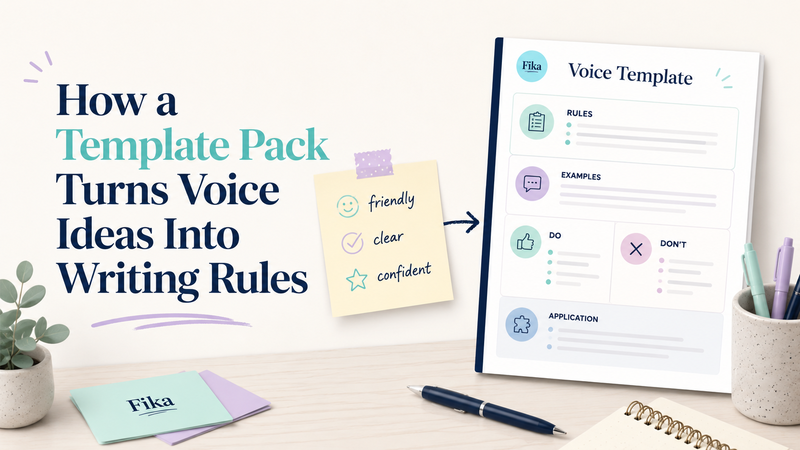
They know the brand should sound clear, helpful, expert, friendly, confident, or human. They may have a few notes from strategy work, a short brand deck, a messaging document, or examples of content they like. But when someone needs to write a landing page, edit an email, review an AI draft, or brief a freelancer, those ideas are often too loose to guide the actual work.
This is where a template pack becomes useful. It helps turn broad voice ideas into writing rules that people can apply while creating content.
A voice idea describes the direction. A writing rule explains what to do with that direction.
Voice ideas are usually too broad on their own
Most brand voice ideas begin as general descriptions. For example:
“We want to sound friendly.”
“The brand should feel expert but not cold.”
“Our content should be simple and helpful.”
“We need a more confident tone.”
“We do not want to sound generic.”
These are good starting points, but they do not yet answer practical writing questions.
What does friendly mean in a pricing section?
How does expert sound in a short social post?
What makes a confident CTA different from a pushy one?
When should the brand explain more, and when should it stay concise?
Without answers like these, every writer interprets the same voice idea differently. One person makes the content more casual. Another makes it more formal. Another adds more claims. Another removes detail to make it “simple.”
The result is not a clear voice system. It is a collection of personal interpretations.
A template creates structure around the idea
A template pack helps because it gives each voice idea a place to become more specific.
Instead of stopping at “sound clear,” the team can define:
what clear writing should do;
what unclear writing usually looks like;
where clarity matters most;
how much explanation the reader needs;
what examples or proof should support the message.
This changes the voice from a vague preference into a practical rule.
For example, “clear” can become:
“Explain the main point before adding supporting details. Avoid abstract claims when a specific example can make the message easier to understand.”
That is easier to use than just “be clear.”
The same can happen with other traits. “Friendly” can become a rule about reducing pressure and using helpful language. “Expert” can become a rule about being specific, grounded, and useful. “Confident” can become a rule about making direct claims only when the content supports them.
Rules make voice easier to apply while writing
The real value of a brand voice document appears during content work.
A writer does not need a beautiful document that only describes the brand personality. A writer needs guidance that helps with decisions such as:
how direct the headline should be;
how much context the introduction needs;
whether the CTA should feel urgent or calm;
when to use examples;
when to avoid humor;
when to explain limitations;
how to keep AI-generated content from sounding generic.
A template pack helps organize these decisions so they are not handled from scratch every time.
This is especially useful for teams that work with different writers, editors, freelancers, AI tools, or content formats. The more people create content for the same brand, the more important repeatable rules become.
A practical example of this process is explained here: https://medium.com/@wwwebadvisor/how-to-use-a-tone-of-voice-template-pack-to-build-practical-brand-voice-documents-15a574a609c8
Templates also show what the voice should avoid
Good writing rules are not only about what the brand should sound like. They also define what the brand should avoid.
This part is important because many tone problems come from overcorrection.
A team wants to sound friendly, so the content becomes too casual.
A team wants to sound confident, so the copy becomes exaggerated.
A team wants to sound expert, so the writing becomes heavy.
A team wants to sound simple, so the content loses useful detail.
A template can prevent this by asking the team to define boundaries.
For example:
friendly, but not childish;
expert, but not full of jargon;
confident, but not overpromising;
simple, but not empty;
human, but not overly casual.
These boundaries make the rules safer and easier to apply.
Examples turn rules into usable references
A voice rule becomes much stronger when it includes examples.
For instance, a rule might say:
“Use specific, helpful explanations instead of broad claims.”
But a before-and-after example makes that rule easier to understand.
Weak version:
“Create amazing content that transforms your brand.”
Stronger version:
“Use shared voice rules so writers can make consistent decisions across landing pages, emails, and product content.”
The stronger version is less dramatic, but more useful. It shows the kind of wording the team should aim for.
This is why the previous Fika article focused on the problem with relying only on tone adjectives: https://digitalowl.fika.bar/why-brand-voice-documents-need-more-than-tone-adjectives-01KWMTEQQHZMSYTJXX7FZRA4B9
Adjectives can name the direction, but examples show how that direction should appear in real content.
Final thought
A template pack does not replace brand thinking. It gives that thinking a practical shape.
It turns loose voice ideas into rules, boundaries, examples, and review points. That makes the voice easier to use when writing, editing, briefing, onboarding, or working with AI-generated drafts.
Without structure, voice ideas stay abstract. With the right template, they become a working system for consistent content.
Comments
No comments yet. Be the first to comment!