What to Include in a Practical Brand Voice Document
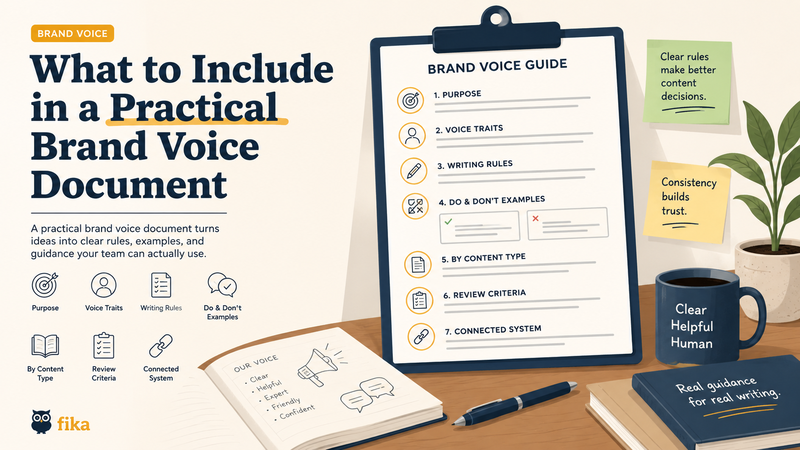
A brand voice document should not be a decorative file that people open once and forget. It should help writers, editors, marketers, founders, and content reviewers make better decisions when they create real content.
That is why a practical brand voice document needs more than a short description of the brand personality. It should explain how the voice works, what it changes in writing, what the team should avoid, and how people can check whether a draft fits the expected tone.
A useful document does not need to be huge. But it does need to be clear enough to support daily content work.
Start with the purpose of the voice
Before listing traits, explain why the brand voice matters.
This section should answer a simple question: what should the voice help the brand do?
For example, the goal may be to:
make complex topics easier to understand;
help readers feel guided instead of pressured;
make product pages more consistent;
reduce vague or generic AI-generated content;
help freelancers understand the brand faster;
make review feedback more objective;
keep emails, landing pages, and articles aligned.
This gives the document a practical reason to exist. The voice is not just about sounding nice. It is about helping the brand communicate more consistently.
A full example of how a template pack can support this process is explained here: https://medium.com/@wwwebadvisor/how-to-use-a-tone-of-voice-template-pack-to-build-practical-brand-voice-documents-15a574a609c8
Define the main voice traits
The document should include the main traits that describe the voice. But this part should not stop at adjectives.
Words like clear, friendly, expert, confident, helpful, or human can be useful, but only if each one is explained.
For every trait, include:
what the trait means for this brand;
what it should change in the writing;
where it matters most;
what it should not become.
For example, “friendly” may mean:
“Use simple, helpful language that makes the reader feel guided. Avoid forced jokes, childish phrasing, or overly casual wording in serious content.”
This is much more useful than simply writing “we are friendly.”
Add practical writing rules
A good brand voice document should include rules that writers can actually apply.
These rules may cover:
how to write introductions;
how direct the brand should sound;
how to explain benefits;
how to use examples;
how to write calls to action;
how much detail to include;
how to avoid hype;
how to simplify without removing meaning.
This is where broad voice ideas become useful writing guidance.
For example, instead of saying:
“Sound confident.”
The rule can say:
“Make claims clearly, but support them with a reason, example, limitation, or practical context. Avoid exaggerated promises.”
That kind of rule is easier to use during writing and editing.
Include do and don’t examples
Examples are one of the most important parts of a practical voice document.
Without examples, different people may still interpret the same rule differently. With examples, the team can see the expected direction.
A simple format works well:
Weak version:
“Unlock powerful content success with a game-changing brand voice.”
Stronger version:
“Use shared voice rules so writers can make consistent decisions across landing pages, emails, and product content.”
The stronger version is more specific, more controlled, and easier to trust.
This connects closely with the previous Fika article about turning voice ideas into writing rules: https://digitalowl.fika.bar/how-a-template-pack-turns-voice-ideas-into-writing-rules-01KWMV74371Z16KBF0VCDVHG6T
The goal is not to give writers sentences to copy. The goal is to show the level of clarity, detail, and tone the brand expects.
Explain how the voice changes by content type
A practical brand voice document should not treat every piece of content the same way.
The same brand may need to sound slightly different across:
homepage copy;
product pages;
landing pages;
emails;
support replies;
onboarding content;
blog articles;
social posts;
AI-assisted drafts.
This does not mean the voice becomes inconsistent. It means the voice adapts to the reader’s situation.
For example, a support reply may need to be calm and direct. A landing page may need to be sharper and more persuasive. A blog article may need more explanation. An onboarding email may need reassurance.
A useful document should explain these differences so writers do not apply one tone rule too rigidly everywhere.
Add review criteria
A brand voice document becomes more valuable when it helps with content review.
Instead of giving vague feedback like “make it more on-brand,” the reviewer can check specific criteria:
Is the message clear?
Is the tone appropriate for the reader’s situation?
Are claims specific enough?
Is the CTA aligned with the page?
Does the content avoid hype or generic phrasing?
Does the draft sound like the same brand as other content?
Is the voice consistent without feeling mechanical?
These criteria make feedback easier to understand and easier to act on.
They are also useful when reviewing AI-generated drafts, because AI content often sounds polished but generic. A voice document gives the team a way to check whether the draft actually fits the brand.
Connect the document to the wider voice system
A brand voice document works best when it connects to the broader content system. It should not sit alone.
It can connect to a main tone of voice guide, use cases, examples, checklists, and content review workflows. This helps the team understand not only what the voice is, but how to use it in real marketing content.
For a broader overview of tone of voice in marketing content, use the main hub here: https://volodymyrzh.medium.com/tone-of-voice-in-marketing-content-9f702ee8de3c
The hub can support the bigger strategic picture, while the practical document gives writers the working rules they need.
Final thought
A practical brand voice document should help people write, review, and align content.
It should include the purpose of the voice, clear traits, writing rules, boundaries, examples, content-type guidance, and review criteria. Without these parts, the document may sound polished but still be hard to use.
The best brand voice documents do not only describe how a brand wants to sound. They show how that voice should work in real content decisions.
Comments
No comments yet. Be the first to comment!