Digitalowl
- Home
- Why Beginners Should Build Small Projects Before Learning Everything
- What to Power First During a 72-Hour Blackout
Recent posts
-
Does Fast Charging Shorten Battery Life?
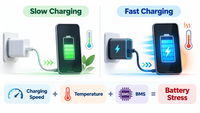
Fast charging is convenient, but does it damage a battery or make it wear out faster? The answer depends on charging power, battery chemistry, temperature, state of charge and how the battery management system controls the process. Faster charging can increase stress inside battery cells, but it does not automatically cause significant damage every time it is used. Modern smartphones, electric veh…
- batteries
- blackout
- +3
-
Cycle Life vs Calendar Life: What Ages a Battery Faster?
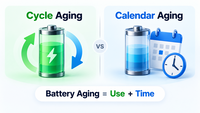
A rechargeable battery can lose capacity even when it is rarely used. Another battery may experience thousands of charging cycles while remaining useful for years. This happens because battery ageing is driven by both usage and time. Cycle life describes how a battery performs under repeated charging and discharging. Calendar life describes how its performance changes as time passes, including per…
- batteries
- blackout
- +3
-
What Does 80% Battery Health Actually Mean?
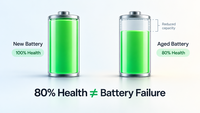
A battery health reading of 80% can sound alarming, especially when a device previously displayed 100%. But 80% battery health does not mean the battery is 80% charged, 80% damaged or about to stop working. In many cases, it means the battery's estimated maximum capacity has declined to approximately 80% of its original reference capacity. That distinction matters for smartphones, laptops, electri…
- batteries
- blackout
- +1
-
State of Charge vs Depth of Discharge: What's the Difference?
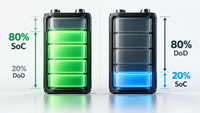
State of Charge (SoC) and Depth of Discharge (DoD) describe two sides of the same battery measurement. SoC tells you how much charge remains relative to a defined full-charge capacity, while DoD tells you how much of that capacity has been used. Both are usually expressed as percentages, but they answer opposite questions. A battery at 80% State of Charge has a Depth of Discharge of 20%. At 50% So…
- batteries
- blackout
- +2
-
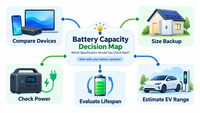
Battery Capacity Decision Map: Which Specification Should You Check Next?
Battery Capacity Decision Map: Which Specification Should You Check Next? Choosing a battery becomes much easier when you know which specification answers your actual question. Battery capacity, usable energy, power output, runtime, cycle life and charging performance are related, but they are not interchangeable. Looking at the wrong number can lead to buying too little capacity, paying for unnec…
- blackout
- electricity
- +3
-
EV Battery Capacity in kWh: What It Means for Energy and Driving Range
Electric vehicle battery capacity is usually measured in kilowatt-hours (kWh). This number tells you how much electrical energy a battery can store, but it does not directly tell you how far an electric car will travel on a charge. A 60 kWh EV battery may provide very different driving ranges depending on the vehicle, speed, temperature, terrain and energy consumption. Understanding EV battery cap…

- batteries
- electricity
-
Battery Capacity Sizing Checklist: From Loads to Final Reserve
Battery sizing becomes much easier when you stop looking for one magic number and instead move through the calculation in a fixed order. The practical sequence is: needs → load → runtime → energy → losses → reserve → power check → recharge This checklist turns battery sizing into a repeatable decision process rather than a guess. For the broader capacity framework: https://medium.com/@volodymyrzh/…

- batteries
- blackout
- +3
-
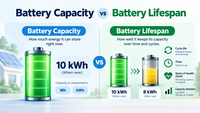
Battery Capacity vs Battery Lifespan: What’s the Difference?
Battery capacity and battery lifespan are closely related, but they are not the same thing. Capacity tells you how much energy a battery can store or deliver now. Lifespan tells you how that performance changes over time. A battery can have a large capacity and still be old. It can also have a relatively small capacity and still be in excellent health. For the broad battery-capacity framework: htt…
- batteries
- blackout
- +4
-
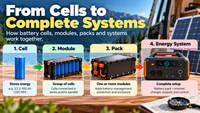
Battery Modules and Packs Explained: From Cells to Complete Energy Systems
Battery specifications often jump directly from individual cells to a complete battery pack, but there is usually another layer in between: the module. Understanding the hierarchy from cell → module → pack → system makes it much easier to understand voltage, capacity, expandability and why large battery systems are built from many smaller components. For the broad battery-capacity framework: https…
- batteries
- blackout
- +2
-
How to Size Battery Capacity for Multiple Devices
Sizing a battery for one device is relatively simple. Sizing for several devices is harder because you must answer two different questions at the same time: how much power might the devices need simultaneously, and how much energy will they consume over the full operating period? Those are not the same calculation. A system can have enough battery capacity in Wh but still fail because the inverter…

- batteries
- content
- +5
-
How Much Battery Reserve Margin Do You Need?
Sizing a battery exactly to the calculated load may look efficient, but it leaves little room for real-world uncertainty. Energy consumption changes, conversion losses vary, batteries age, temperatures affect performance, and additional devices often appear after the original calculation. That is why practical battery sizing usually includes a reserve margin: extra capacity beyond the calculated m…

- batteries
- blackout
- +3
-
How to Compare Portable Power Stations Without Focusing on the Wrong Specs
Portable power stations are easy to compare badly. One model may advertise 1,000 Wh. Another highlights 1,800 W output. A third promotes 3,000 cycles, fast charging or expandable batteries. All of those numbers can matter, but they answer different questions. The useful comparison is not “Which specification is biggest?” It is which specification matters for your use case. For the broad battery-ca…

- batteries
- blackout
- +1
-
Airline Battery Limits in Watt-Hours: How to Check Before You Fly
Airlines regulate lithium batteries primarily by watt-hours (Wh) rather than by mAh. That matters for phones, laptops, cameras, drones and especially power banks because Wh describes stored energy and allows batteries with different voltages to be compared on the same scale. The practical rule is simple: find the Wh rating before you fly, identify whether the battery is installed or spare, and the…

- batteries
- electricity
- +1
-
Phone vs Laptop Battery Capacity: Why mAh Alone Is Not Enough
A phone may have a 5,000 mAh battery while a laptop is labelled 60 Wh. At first glance, those numbers are difficult to compare because they use different units. The important point is that mAh measures electric charge, while Wh measures stored energy. To compare a phone battery with a laptop battery properly, voltage must be included. For the broader battery-capacity framework: https://medium.com/…

- batteries
- blackout
- +3
-
Power Bank Capacity Explained: mAh, Wh and Real Usable Energy
A power bank may be labelled 10,000 mAh, 20,000 mAh or even 30,000 mAh, but that number does not tell you exactly how much energy will reach your phone, tablet or other device. The reason is simple: the advertised mAh rating usually refers to the internal battery cells, while the USB output operates at a different voltage and introduces conversion losses. Understanding power bank capacity therefor…

- blackout
- electricity
- +2
-
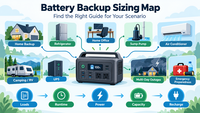
Battery Backup Sizing Map: Find the Right Guide for Your Scenario
Battery backup sizing becomes confusing when every scenario is treated as the same problem. A refrigerator, home office, air conditioner, RV and multi-day outage all require different assumptions. The easiest approach is to begin with the load and outage scenario, then move to the appropriate sizing method. This guide acts as a map across the main battery-backup use cases. Start With Three Questio…
- batteries
- blackout
- +4
-
Battery Capacity for Emergency Preparedness
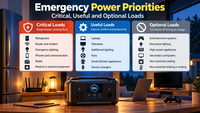
Emergency battery planning is different from buying the largest battery you can afford. The goal is not to keep every appliance running as if the grid were still available. The goal is to identify the loads that matter most, calculate how much energy they require, and build enough battery capacity to support those priorities for a realistic period. That starts with one simple question: What absolu…
- batteries
- blackout
- +3
-
Battery Capacity for Multi-Day Outages
Sizing a battery for a few hours of backup is relatively simple. Multi-day outages are harder because energy use accumulates, weather can affect solar recharging, and essential loads may change from one day to the next. A useful starting point is: daily energy use × number of days = base storage requirement Then adjust for: solar or generator recharging; conversion losses; reserve capacity; exp…

- batteries
- blackout
- +3