Why Traffic Does Not Always Turn Into Leads
More traffic usually feels like a clear win. More people visit the website, analytics start looking better, and the site seems more active than before. For many website owners, this creates the impression that growth is already happening.
But traffic and leads are not the same thing. Traffic means people arrived. Leads mean people trusted the website enough to take the next step. Between those two points, a lot can go wrong.
A visitor may open the page, read a few sections, and leave without doing anything. They may like the topic but not understand the offer. They may be interested but not ready to contact anyone. They may click a button, wait too long, lose confidence, and close the page.
This is why a website can attract visitors and still produce weak business results. Traffic creates opportunity, but the website experience decides how much of that opportunity turns into action.
Traffic is only the beginning
Traffic answers one question: are people arriving?
Lead generation asks a different question: what happens after they arrive?
A visitor still needs to understand where they are, what the website offers, why it matters, and what they should do next. If the page does not answer those questions clearly, the visit may end without a lead. The traffic source may be good, but the page may fail to continue the journey.
This often happens when content attracts attention but does not guide action. A blog post may explain a topic well, but never move the reader toward a related service, product, form, or deeper article. A landing page may receive clicks, but the offer may feel vague. A contact page may exist, but the visitor may not feel enough trust to use it.
Traffic is the opening of the conversation. It is not the final result.
Why visitors leave without becoming leads
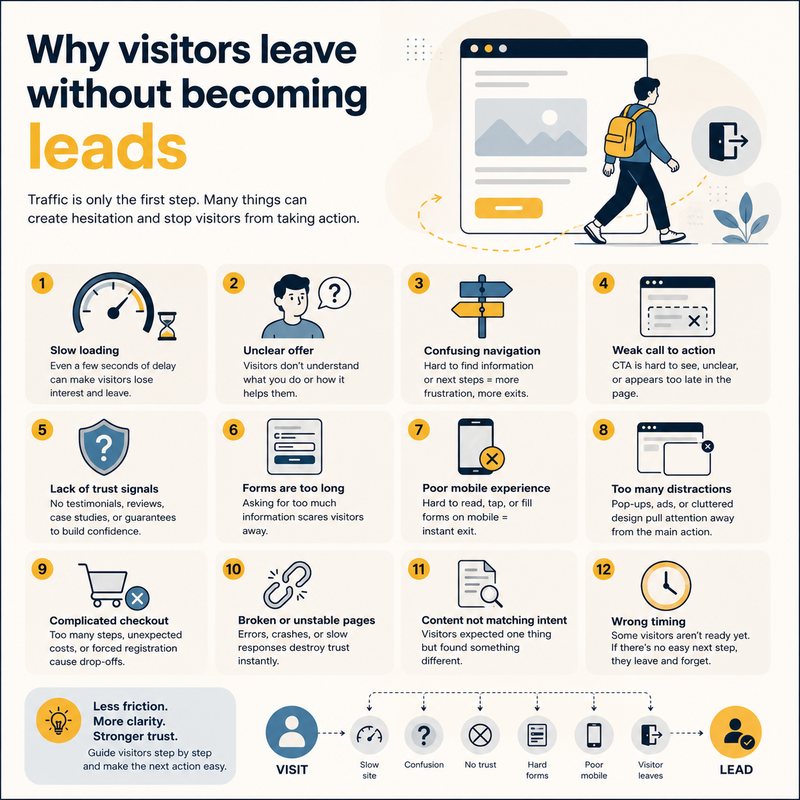
Most people do not leave a website for one dramatic reason. They leave because several small things create hesitation.
The page may load a little too slowly. The headline may not match what they expected. The first screen may not explain enough. The call to action may be too far down the page. The form may feel too long. The website may look active, but not trustworthy enough.
Common reasons traffic does not become leads include:
slow loading on important pages;
unclear offer or weak positioning;
poor match between search intent and page content;
confusing navigation;
weak call-to-action placement;
missing trust signals;
forms that ask for too much too early;
poor mobile experience;
unstable checkout or contact steps;
too many distractions before the action;
content that informs but does not move the reader forward.
Some of these are marketing issues. Some are design issues. Some are technical issues. In practice, they often work together.
A visitor may not think, “This website has a conversion problem.” They may simply feel that continuing is not worth the effort.
Speed matters when the visitor is close to action
Website speed becomes especially important near the decision point.
A reader may tolerate a slightly slow article if the information is useful. But a slow contact form, landing page, checkout page, pricing page, or booking page creates a different kind of friction. These are the pages where the visitor is supposed to act. If they feel slow or unstable, confidence drops.
That is why speed should not be treated only as a technical metric. It affects how professional the website feels. It affects how safe the next step feels. It affects whether the visitor keeps momentum or starts hesitating.
This is the main idea behind the core article from the main queue:
https://medium.com/@wwwebadvisor/how-website-speed-affects-conversions-489751a34a01
A fast website does not guarantee leads by itself. But a slow website can weaken every other part of the conversion path. Even strong content, good traffic, and a useful offer can lose value if the user experience feels heavy at the wrong moment.
More traffic can reveal weak infrastructure
A website can look fine when traffic is low.
Pages may load normally. Forms may work without visible problems. The admin area may feel acceptable. Nothing looks urgent because only a small number of visitors use the site at the same time.
But when traffic grows, hidden weaknesses become easier to see. The same hosting setup, plugins, database, scripts, media files, and forms now have to handle more activity. If the site was already close to its limits, more visitors can create inconsistent performance instead of more leads.
This is why traffic growth and lead growth are not always equal. A site may receive more attention, but the infrastructure may not be ready to support that attention.
A related Fika article explains this growth problem from the hosting side:
https://digitalowl.fika.bar/the-growth-ceiling-created-by-weak-hosting-01KRPDVSM0Q4Z1B3GGADPVRZ4K
That point matters because weak hosting does not always create a complete failure. The website may stay online. The pages may still load. But the experience may become slower, less stable, and less convincing exactly when visitors are deciding whether to continue.
Traffic quality also matters
Not all traffic has the same value.
Some visitors arrive with strong intent. They are looking for a solution, comparing providers, checking prices, or preparing to contact someone. Other visitors are only curious. Some came from a broad social post. Some clicked because of a catchy headline. Some are researching a topic but are not ready to take action.
This means more traffic can still produce weak results if the visitors are not aligned with the offer.
A useful lead path needs three things to work together:
the right visitor;
the right message;
the right website experience.
If the visitor wants basic education, but the page immediately pushes a sales message, the action may feel too early. If the visitor is ready to buy, but the page only gives broad information, the path may feel incomplete. If the visitor is interested, but the site loads slowly or the form feels awkward, the lead may be lost.
Good traffic gives the website a chance. Good page experience turns that chance into movement.
The page must match the visitor’s expectation
Many conversion problems start before the visitor even reads the page.
A search result, social post, ad, or referral link creates an expectation. The visitor clicks because they expect something specific. If the page does not match that expectation quickly, they may leave even if the content is not bad.
For example, a person searching for website speed and conversions probably wants to understand how performance affects business results. If the page only talks about generic design tips, the match is weak. If the page explains the relationship between speed, trust, forms, checkout, and user behavior, the match is much stronger.
The same logic applies across the funnel. A broad article can attract attention, but it should point to a more specific next step. A specific article can build trust, but it should make the action clear. A conversion page can ask for contact, but it must remove doubt first.
This is why internal links are important. They help move the visitor from one stage of interest to the next.
Internal links help turn attention into a journey
A visitor may not become a lead after one page. That does not mean the visit has no value.
Sometimes the reader needs more context. Sometimes they need to understand the problem better. Sometimes they need to compare options. Sometimes they need to see the same idea from another angle before they trust the next step.
Internal links help create that path. They turn separate pages into a connected journey instead of isolated pieces of content.
For example, a visitor reading about traffic and leads may also need to understand why website performance becomes inconsistent as a site grows. That context is useful because inconsistent performance often affects trust and conversion before the site owner notices the pattern.
A relevant supporting article from Fika is:
This kind of link works because it does not interrupt the reader. It continues the topic. It gives the visitor another useful explanation and keeps them inside the content funnel.
Slow websites create hesitation
Lead generation depends on momentum.
When a visitor is interested, the website should make the next step feel easy. The page should load smoothly. The offer should be clear. The button should be visible. The form should feel simple. The confirmation should happen without delay.
A slow website breaks that momentum.
The visitor may start wondering whether the business is reliable. They may compare another option. They may decide to return later. They may abandon the form. None of this has to look dramatic in analytics. It may simply appear as traffic with very few leads.
A related Fika article explains the cost side of this problem:
The hidden cost of slow performance is not only waiting time. It can include lost inquiries, weaker trust, lower engagement, and wasted traffic from channels that were difficult or expensive to build.
Forms are often the final weak point
The lead form is where the conversion actually happens.
A website can attract the right visitor, explain the offer well, and build enough interest. But if the form feels too long, too slow, or too demanding, the visitor may stop at the final step. That is one of the most frustrating types of conversion loss because the user was already close to action.
A strong form does not need to be complicated. It needs to feel reasonable for the situation. A simple inquiry form should not ask for too much information. A quote request may need more details, but those fields should still feel justified. A booking form should be easy to complete on mobile.
Good lead forms usually have:
clear field labels;
only necessary questions;
visible submit button;
fast response after submission;
short explanation of what happens next;
mobile-friendly layout;
trust signals near the form.
The form should feel like the natural next step. It should not feel like a test of patience.
Trust signals support conversion
Visitors often arrive without knowing the business.
That means the website has to build trust quickly. The visitor silently checks whether the page feels real, current, professional, and relevant. They look for signs that the business understands their problem and can actually help.
Trust signals can include clear contact information, real examples, client types, testimonials, case studies, process explanations, pricing guidance, updated content, secure browsing, and helpful internal links. These details make the next step feel less risky.
But trust is not built by one badge or one sentence. It comes from the full experience.
If the site is slow, confusing, outdated, or unstable, trust becomes harder to build. If the content is clear, the page loads well, and the next step feels simple, trust becomes easier.
That is why performance and content should work together. A fast but confusing page may not convert. A clear but slow page may still lose visitors. The strongest result comes when the message, structure, and technical experience support the same goal.
Analytics should look beyond traffic
Traffic reports can be misleading when viewed alone.
A page may receive many visits but produce almost no leads. Another page may receive fewer visits but bring better inquiries. A traffic source may look successful because it sends users, but those users may not match the offer. A blog post may attract readers, but fail to guide them toward a useful next step.
To understand the real problem, traffic should be reviewed together with conversion behavior.
Useful questions include:
Which pages bring visitors who take action?
Which pages get traffic but no leads?
Are mobile users converting worse than desktop users?
Do high-traffic articles link to relevant next steps?
Are slow pages also weak conversion pages?
Do visitors leave before reaching the form?
Is the call to action visible at the right moment?
Does the page match the intent that brought the visitor there?
These questions help separate visibility problems from conversion problems.
If traffic is low, the website may need more reach. If traffic is growing but leads are not, the website may need a better path from interest to action.
Better conversion starts with removing friction
Turning more visitors into leads does not always require a full redesign.
Often, the first step is to remove the biggest points of friction. The website should make the next action easier, clearer, and more trustworthy. It should reduce hesitation instead of creating more of it.
A practical improvement process can start with the pages that already receive traffic. Check whether those pages have clear internal links, visible calls to action, fast loading, simple forms, and enough trust signals. Then look at the pages where visitors are supposed to act: contact pages, checkout pages, booking pages, pricing pages, and main service pages.
The goal is not to push every visitor aggressively. The goal is to give interested visitors a logical next step.
That next step might be reading a deeper article, viewing a service page, checking a comparison, requesting a quote, booking a call, starting checkout, or filling out a short form. The right step depends on where the visitor is in the decision process.
Traffic becomes valuable when the website is ready
Traffic is not useless when it does not immediately convert. Some visitors need time. Some return later. Some read several pieces of content before taking action. Some discover the brand through one article and convert after another.
But traffic becomes much more valuable when the website is ready for it.
A lead-generating website does not only attract visitors. It helps them understand the problem, trust the solution, and move to the next step. It loads quickly enough to protect momentum. It explains clearly enough to reduce confusion. It uses internal links to continue the journey. It makes forms and decision pages feel safe.
More traffic can help a strong website grow faster. But if the website is slow, unclear, or unstable, more traffic may only reveal the weaknesses more clearly.
The better question is not only “How do we get more visitors?”
It is also “What happens to visitors after they arrive?”
That is where traffic starts becoming leads.
Comments
No comments yet. Be the first to comment!