The Growth Ceiling Created by Weak Hosting
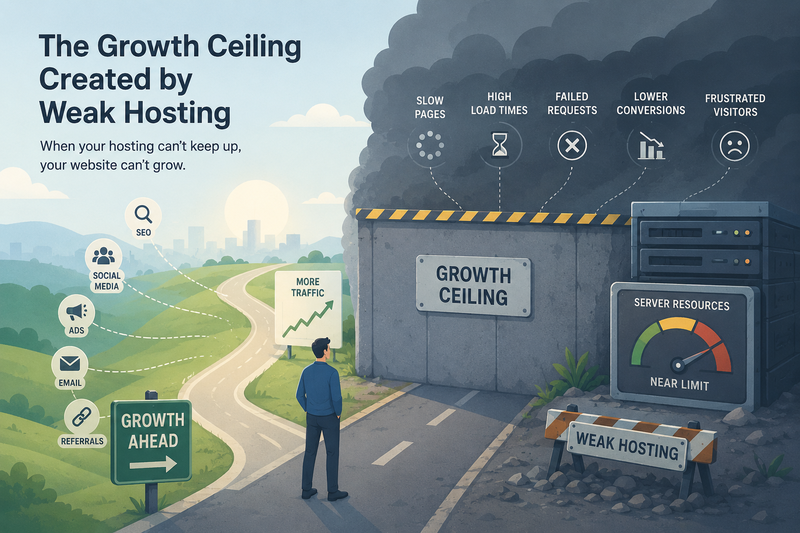
You publish more content. You attract more visitors. You add more pages, tools, forms, images, plugins, tracking scripts, and business features. The website becomes more useful, more active, and more important for the business.
But growth also creates pressure.
A website that worked well at the beginning may start feeling slower later, not because something is suddenly broken, but because the hosting environment can no longer support what the site is becoming. This is where weak hosting creates a growth ceiling.
The site may still be online. Pages may still open. The admin panel may still work. But everything starts to feel less stable, less smooth, and less predictable.
What a growth ceiling looks like
A growth ceiling does not always appear as one dramatic failure.
More often, it appears slowly. The website keeps working, but every improvement becomes harder. The site owner adds new content, but performance gets worse. Traffic increases, but results do not grow at the same pace. Marketing efforts bring more visitors, but the website struggles to handle them smoothly.
This can look like:
pages taking longer to load during busy periods;
the admin area becoming slower as content grows;
plugins creating more pressure than before;
forms and checkout pages feeling less reliable;
traffic spikes causing sudden performance drops;
optimization work producing smaller improvements over time;
visitors leaving before the website has a chance to convert them.
The problem is not only speed. It is the loss of room to grow.
When hosting resources are too limited, the website reaches a point where adding more traffic, more content, or more business activity creates friction instead of progress.
Weak hosting can hide the real problem
One of the difficult parts of hosting-related growth limits is that they can look like other problems.
A slow website may look like a design issue. A weak conversion rate may look like a copywriting issue. A slow admin panel may look like a WordPress issue. A heavy page may look like an image issue. A checkout problem may look like a plugin issue.
Sometimes those things really are part of the problem. But if the hosting layer is too weak, every other issue becomes harder to fix.
For example, optimizing images can help, but it will not fully solve weak server response. Removing unnecessary plugins can help, but it may not be enough if the hosting plan has strict CPU, memory, or database limits. Caching can help many pages, but it cannot solve every dynamic request, admin action, form submission, or checkout process.
This is why weak hosting can quietly hold the whole website back.
Growth adds more work for the server
A small website and a growing website do not use hosting resources in the same way.
At the beginning, a site may only have a few pages and light traffic. The server has less to process. There are fewer database queries, fewer files, fewer scripts, and fewer simultaneous requests.
As the website grows, more work appears:
more visitors open pages at the same time;
more posts, pages, and media files are stored;
more plugins run background tasks;
more tracking scripts and integrations load;
more forms, carts, or account features need processing;
more database queries happen behind the scenes;
more backups, scans, and scheduled actions run regularly.
Each item may seem small by itself. Together, they create a heavier website.
If the hosting environment has enough resources, this growth can be managed. If the hosting environment is too limited, the website starts hitting its ceiling.
The ceiling affects marketing too
A weak hosting setup does not only affect technical performance. It can also reduce the value of marketing.
Content marketing, SEO, ads, social media, email, and referrals all depend on the website being ready when people arrive. If the site is slow or inconsistent, more traffic does not automatically mean better results.
This creates a frustrating situation.
The business works harder to attract visitors, but the website converts fewer of them. More people arrive, but fewer continue. Pages rank, but visitors do not stay long enough. Campaigns send traffic, but the experience is not strong enough to support the goal.
At that point, the website is not just a destination. It becomes a filter that removes part of the value from every marketing channel.
That is the hidden danger of a growth ceiling. You may think you need more traffic, when first you need the website to handle the traffic you already have.
Better hosting gives the website more room
Better hosting does not magically fix every website problem.
A badly built website can still be slow on stronger hosting. Large images, bloated themes, unnecessary plugins, poor scripts, and weak database structure still matter. But stronger hosting gives the website more room to handle growth before performance becomes a constant obstacle.
A better setup can support:
faster server response;
more stable performance during traffic spikes;
smoother admin work;
better handling of dynamic pages;
more reliable forms and checkout processes;
stronger performance under real user activity;
more flexibility as the site becomes larger.
This matters because growth is not only about today’s traffic. It is also about what the website needs to support next month, next campaign, or next stage of the business.
When cheap hosting becomes the bottleneck
Cheap hosting can be reasonable for a small, simple website. There is nothing wrong with starting lean when the site does not yet need much.
The problem begins when the website grows but the hosting setup stays the same.
At that stage, the low monthly price may still look attractive, but the hidden cost becomes larger. The site becomes harder to improve. Visitors get a weaker experience. Business results become less consistent. The website starts limiting the very growth it was supposed to support.
For a deeper explanation of this problem, read this full guide:
https://volodymyrzh.medium.com/why-cheap-hosting-becomes-expensive-over-time-e08193b9387c
Final thought
Weak hosting does not always stop a website immediately.
Sometimes it does something more subtle. It creates a ceiling. The website can still function, but it cannot grow smoothly. Every new visitor, plugin, page, campaign, or feature adds more pressure. Instead of supporting progress, the infrastructure starts resisting it.
That is why hosting should not be judged only by price.
It should be judged by whether it gives the website enough room to grow.
Comments
No comments yet. Be the first to comment!