Why a Slow Website Can Cost More Than Better Hosting

A slow website often feels like a technical inconvenience. Pages load a little later. Forms react a little slower. Visitors wait a few extra seconds. At first, this may not look serious enough to justify paying more for better hosting.
But the real cost of a slow website is not always visible in the hosting invoice.
It shows up in missed leads, lost sales, weaker trust, lower engagement, and wasted traffic. A cheap hosting plan may save a small amount each month, but if it quietly reduces the value of every visitor, the business can lose much more than it saves.
The hosting bill is not the full cost
Many website owners compare hosting plans only by monthly price.
One plan costs less. Another plan costs more. The cheaper option looks smarter because the difference feels clear and measurable.
But website performance affects things that are harder to see immediately:
how long visitors stay;
whether they trust the website;
whether they complete a form;
whether they continue to checkout;
whether they return later;
whether paid or organic traffic produces results.
A website does not need to crash completely to create losses. It only needs to feel slow, unstable, or frustrating at the wrong moment.
That is why weak hosting can become expensive even when the monthly plan still looks cheap.
Slow pages waste good traffic
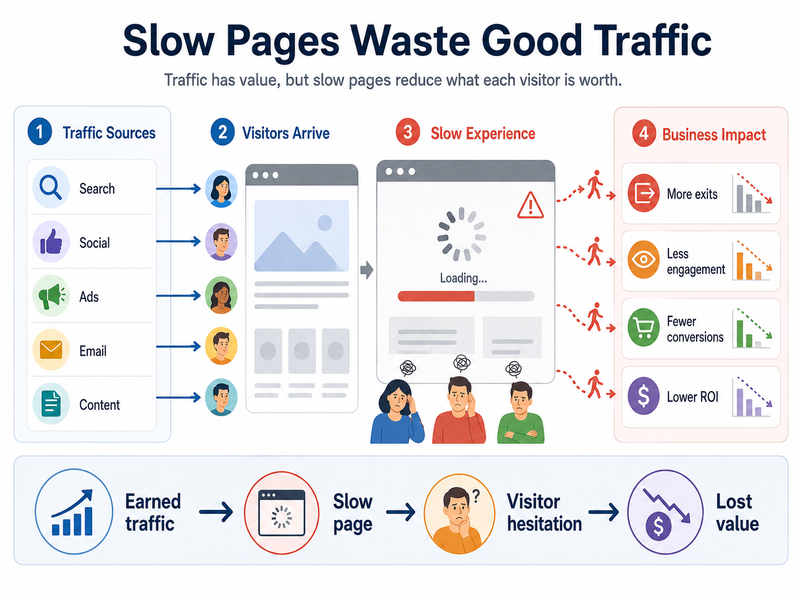
Traffic has value.
If people find your website through search, social media, referrals, ads, newsletters, or content marketing, that attention was earned somehow. Maybe you invested time in writing articles. Maybe you worked on SEO. Maybe you paid for promotion. Maybe you built trust over months.
When visitors arrive and the site feels slow, part of that value disappears.
Some users leave before the page fully loads. Others stay, but lose patience faster. Some read less, click less, or hesitate before taking action. The website may still receive visits, but fewer of those visits turn into useful business results.
This is where slow hosting becomes more than a technical problem. It starts reducing the return on everything else you do to bring people to the site.
Small savings can create bigger losses
Imagine saving a small amount each month on hosting.
Now compare that with losing only a few potential customers, leads, orders, or inquiries because the website feels unreliable. In many cases, one missed conversion can cost more than the monthly difference between weak hosting and a better setup.
The problem is that the loss is not always obvious.
You may not see a message saying, “This visitor left because the site was too slow.” You may only see weaker results:
traffic grows, but leads do not;
visitors open pages, but do not continue;
checkout starts, but fewer orders finish;
content ranks, but business impact stays low;
users visit once and do not come back.
This can make the website look like a marketing problem, a design problem, or a content problem, when part of the issue is actually infrastructure.
Better hosting is not just an expense
Better hosting should not be viewed only as a bigger bill.
For a growing website, it can be part of protecting the value of the traffic you already have. Faster server response, more stable resources, better handling of traffic spikes, and stronger backend performance can make the whole website feel more reliable.
This matters especially when the site supports real business goals.
A slow personal blog may be annoying. A slow business website can lose inquiries. A slow online store can lose orders. A slow service page can reduce trust before the visitor even reads the offer.
Better hosting does not automatically fix every performance issue. Images, scripts, plugins, themes, tracking tools, and page structure still matter. But when the hosting environment is too limited, optimization alone may not be enough.
The real question is value, not price
The better question is not always:
“Which hosting plan is cheapest?”
A more useful question is:
“Does this hosting protect or reduce the value of my website traffic?”
If the website is small, simple, and low-traffic, a basic plan may be enough for a while. But as the site grows, the cost of weak performance can become larger than the savings from cheap hosting.
That is the turning point.
The website may still work, but it no longer supports growth smoothly. Pages become inconsistent. Admin work becomes slower. Visitors experience delays. Conversions become weaker. The business starts paying for the cheap option in ways that do not appear on the invoice.
For a deeper breakdown of this problem, read this guide:
https://volodymyrzh.medium.com/why-cheap-hosting-becomes-expensive-over-time-e08193b9387c
Final thought
Cheap hosting is not always bad. For the right stage, it can be practical.
But when a website starts receiving more traffic, supporting more content, handling more plugins, or carrying more business responsibility, slow hosting can become a hidden cost. The monthly savings may stay visible, while the lost opportunities remain invisible.
That is why better hosting is not only about speed.
It is about protecting the business value of every visitor who reaches the website.
Comments
No comments yet. Be the first to comment!