The Cheapest Way to Start an Off-Grid Retreat Without Building From Scratch
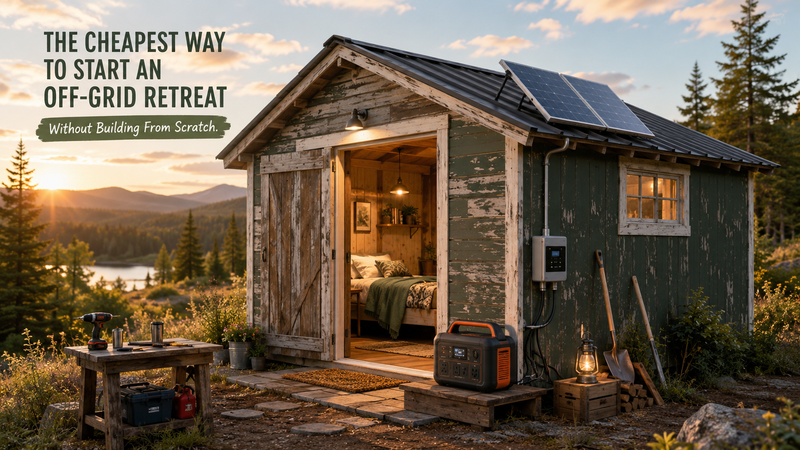
Building an off-grid retreat from scratch sounds exciting, but it can quickly become expensive, slow, and overwhelming. You need land preparation, a foundation, framing, roofing, insulation, power, water, tools, materials, permits, and enough budget to fix mistakes along the way. For a first project, that can be too much.
A more realistic starting point is simpler: instead of building a new structure, look for an existing one that can be repaired, upgraded, and adapted.
An old shed, garage, barn, cabin, trailer, workshop, utility building, or small rural structure may already give you the most expensive part of the project — a physical shell. It may not look impressive yet, but it can provide walls, a roof, shade, storage, and a defined space you can improve step by step.
That is why converting an existing structure can be one of the cheapest ways to start an off-grid retreat.
Why Existing Structures Can Save So Much Money
The structure itself is often one of the biggest costs in any small retreat project. Even a basic cabin needs lumber, roofing, fasteners, windows, doors, insulation, weather protection, tools, and labor. If part of that already exists, you may be starting several steps ahead.
An old building may already have:
a roof;
walls;
a floor or slab;
a door;
some windows;
storage space;
a usable footprint;
access from a road or path.
Of course, not every old structure is worth saving. Some are too damaged, unsafe, wet, unstable, or badly located. But many small structures are not useless. They are simply unfinished opportunities.
Instead of asking, “Can I build an off-grid cabin from scratch?” it may be smarter to ask, “What existing structure could I turn into something useful?”
Start With Shelter, Not Perfection
A beginner off-grid retreat does not need to become a perfect tiny home on day one. It can start as a simple, dry, safe place where you can spend weekends, store tools, test a power setup, cook basic meals, and learn what the site actually needs.
This matters because many people overbuild too early. They imagine a finished dream cabin before they understand the land, the weather, the road access, the amount of sunlight, the water situation, or how often they will actually use the place.
A converted structure lets you move slowly. You can improve it in stages:
Make it dry and secure.
Repair the roof and doors.
Add basic insulation.
Set up temporary power.
Add lighting and charging.
Improve ventilation.
Add better furniture, storage, and comfort later.
This approach reduces risk. You do not need to spend all your money before you know whether the place works for your lifestyle.
The Minimum Viable Off-Grid Retreat
The cheapest useful version of an off-grid retreat is not a luxury cabin. It is a simple structure that solves the basics first.
At minimum, you need:
protection from rain and wind;
a safe place to sleep or rest;
basic lighting;
a way to charge devices;
ventilation;
a simple heat or cooling strategy;
secure storage;
a plan for water;
a plan for waste;
reliable access.
Once these basics are covered, the space becomes usable. It may still be rough, but it is no longer just an abandoned building or empty shell. It becomes a base.
This is why small existing structures are so useful. You can test off-grid living without turning the project into a full construction job. A small space is easier to heat, easier to power, easier to clean, and easier to improve.
Why Small Is Usually Better at the Beginning
A smaller structure is usually cheaper to upgrade than a larger one. It needs fewer materials, less insulation, fewer lights, less power, and less furniture. It is also easier to understand where the problems are.
If a large old building has leaks, drafts, broken floors, and moisture issues, the repair costs can grow quickly. But if a small shed or cabin has one roof, four walls, and a simple layout, the project is easier to control.
Small spaces also work better with basic off-grid systems. A compact retreat can often run on a modest portable power station, a few solar panels, LED lighting, and careful energy use. You do not need to power a full-size house immediately.
That makes small structures ideal for first experiments with:
weekend retreats;
remote work cabins;
tool storage bases;
hunting or fishing cabins;
garden offices;
creative studios;
emergency backup shelters;
seasonal tiny homes.
You can always expand later. But starting small helps you avoid expensive mistakes.
Think in Systems, Not Just Buildings
The structure is only one part of an off-grid retreat. The real question is whether the whole system can work.
Before spending money, look at the site as a complete setup:
Can you reach it in bad weather?
Does the roof stay dry?
Is there enough sunlight for solar power?
Is there space for batteries or a power station?
Can you get mobile signal or satellite internet?
Is there a safe water option?
Can you ventilate the space properly?
Is the structure legally usable?
Can you repair it without spending more than building new?
This is where many cheap projects become expensive. A low-cost structure in the wrong location can turn into a money trap. But a modest structure in the right place can become extremely useful.
The best off-grid retreat is not always the most beautiful one. It is the one that can realistically support your needs.
For a broader look at this idea, here is the full guide on forgotten structures that can become off-grid homes:
https://medium.com/@volodymyrzh/forgotten-structures-that-can-become-off-grid-homes-dc710891907d
The Smartest First Upgrade: Reliable Power
Once the structure is dry and safe, power is often the first major upgrade. Even a very basic retreat becomes much more useful when you can run lights, charge a phone, power a laptop, use small tools, or keep a router running.
For a beginner setup, it is usually better to start simple. You do not need to design a full permanent solar system immediately. A portable power station and solar panel setup can help you test your real energy needs before making bigger decisions.
Start by asking:
How many lights do I need?
Do I need to charge a laptop?
Will I use a small fridge?
Do I need internet equipment?
How many days should the system last without sun?
Will I use the retreat only on weekends or for longer stays?
These answers matter more than buying the biggest setup right away. Off-grid power should match the actual use of the space.
Do Not Ignore Comfort
Cheap does not have to mean miserable. A small retreat becomes much more usable when it feels clean, dry, and comfortable.
Simple comfort upgrades can include:
sealing drafts;
adding basic insulation;
using washable flooring;
improving lighting;
adding shelves;
creating a real sleeping corner;
keeping tools organized;
adding curtains or privacy panels;
using moisture control;
improving ventilation.
These upgrades are not glamorous, but they change how the space feels. A forgotten structure becomes more than storage when it starts to feel intentional.
Comfort also helps you use the retreat more often. If the space is cold, dark, damp, and chaotic, you will avoid it. If it is simple but pleasant, you will keep improving it.
When Converting Is Not Worth It
The cheapest option is not always the best option. Sometimes an old structure is too damaged to save.
Be careful if you see:
major roof collapse;
serious rot;
unstable walls;
foundation movement;
heavy mold;
standing water;
unsafe wiring;
unclear ownership;
no legal access;
repair costs higher than replacement.
In these cases, the structure may look cheap but become expensive later. A low purchase price does not matter if the building requires constant repair or creates safety problems.
The best candidate is not the cheapest structure. It is the structure with the best balance of condition, location, access, repair cost, and future usefulness.
Use Visual Examples Before You Commit
Some ideas are easier to understand visually. Seeing the logic of reuse, conversion, and small-space planning can make the whole concept clearer than reading a checklist alone.
This is especially true when comparing different structure types. A shed, trailer, garage, workshop, or old cabin may all require different levels of repair, different power setups, and different comfort upgrades. A visual explanation can help you think through the project before spending money.
You can watch the related video here:
A Simple Rule for Choosing the Right Structure
A good beginner off-grid retreat should pass one simple test:
Can it become dry, safe, useful, and comfortable without turning into a full-scale construction project?
If the answer is yes, it may be worth considering. If the answer is no, it may be better to walk away.
The goal is not to create a perfect home immediately. The goal is to create a usable base that can grow over time. That is where old structures become interesting. They let you begin with what already exists instead of waiting until you can afford a complete new build.
Final Thought
The cheapest way to start an off-grid retreat is often not to build from scratch. It is to find a structure that already has potential and improve it carefully.
A small shed, garage, cabin, barn, trailer, or workshop may not look impressive at first. But with a dry roof, basic repairs, simple power, better storage, and thoughtful upgrades, it can become a practical off-grid space.
Start small. Fix the basics. Test the site. Upgrade only what matters. That approach is usually cheaper, safer, and smarter than trying to build the perfect retreat from day one.
Comments
No comments yet. Be the first to comment!