Why Contact Forms Need to Feel Fast

A form is a small part of the page, but a big part of conversion
A contact form may look like a simple website element. It usually has only a few fields, a button, and a confirmation message. But for a lead-generation website, this small element often sits very close to the final decision.
Visitors usually reach a form after they have already shown interest. They may have read a service page, checked a landing page, compared options, or decided that the offer is worth a question. At that moment, the website does not need to impress them again. It needs to help them complete the action without friction.
That is why form speed matters. A slow form can make a visitor pause at the exact moment when they were ready to act.
Slow forms create hesitation
A contact form does not need to be broken to hurt conversions. It only needs to feel uncertain.
If the fields load late, the submit button freezes, validation feels delayed, or the confirmation message takes too long, the visitor may start doubting the website. The issue is not only technical. It becomes a trust problem.
This is similar to what happens on slow landing pages. When the page feels heavy before the visitor reaches the next step, the chance of action becomes weaker. This related Fika article explains that landing-page friction more directly:
https://digitalowl.fika.bar/how-slow-landing-pages-reduce-conversions-01KRY9TR4ENX2PRSPE1RP4WR63
Contact forms create the same kind of friction, but closer to the conversion point. That makes the delay even more dangerous.
The visitor is already close to action
A person who opens a contact form is often no longer just browsing. They may be ready to ask for a quote, request details, book a call, or send a business question. This means the form is not only a design element. It is part of the sales path.
If the form feels instant, simple, and stable, the action feels safe. The visitor can move from interest to message without thinking too much about the website itself.
If the form feels slow or unreliable, the visitor may hesitate. They may wonder whether the website is maintained well, whether the company is responsive, or whether the message will even go through.
Common problems that make forms feel slow
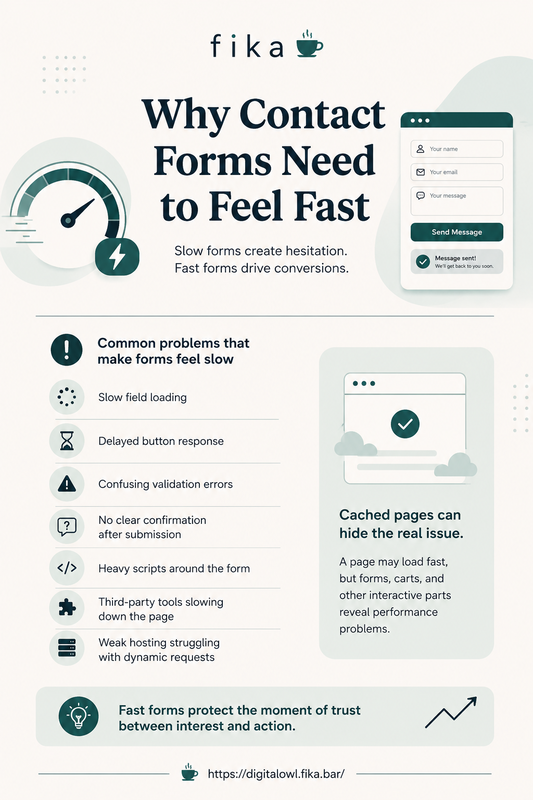
Contact forms can become weak for many reasons. Sometimes the page is overloaded before the visitor even reaches the form. Sometimes the form plugin is heavy. Sometimes scripts for analytics, tracking, spam protection, or CRM integrations add extra delay.
Common form problems include:
slow field loading;
delayed button response;
confusing validation errors;
no clear confirmation after submission;
heavy scripts around the form;
third-party tools slowing down the page;
weak hosting struggling with dynamic requests.
Some of these issues are design problems. Some are plugin problems. Some are tracking-script problems. But sometimes the form is slow because the website does not have enough server resources to handle dynamic actions smoothly.
Cached pages can hide the real issue
A website may look fast when a visitor opens a cached page. The top of the page may appear quickly, and a basic speed test may not look terrible. But the real test often happens when the visitor interacts with something dynamic.
Forms, carts, checkout pages, search boxes, filters, and account areas often reveal problems that a simple page-load score may not show. These elements need the website to respond, process data, check rules, and return a result.
That is why website speed should not be judged only by how quickly the first view appears. A website can load well enough but still lose conversions if the interactive parts feel weak.
Speed protects the moment of trust
Contact forms need to feel fast because they sit between attention and action.
If the form is slow, the visitor has more time to reconsider. If the submit action feels uncertain, the visitor may wonder whether the message was sent at all. If the confirmation is delayed, the website may feel less professional than the offer itself.
For lead-generation websites, this is especially important. A slow form can reduce the value of traffic that was already difficult to earn. SEO, ads, social media, referrals, and content can bring visitors to the page, but the form is often where that attention becomes a real business opportunity.
A fast form does not fix everything, but it removes friction
Better performance does not guarantee more leads by itself. The offer still needs to be clear. The page still needs to answer the visitor’s question. The form still needs to be simple enough to complete.
But when the visitor is ready to act, speed helps remove friction.
A good contact form should feel:
quick to open;
easy to understand;
stable while typing;
responsive after submission;
clear after the message is sent.
This is one reason website speed connects directly to conversion performance. The issue is not only whether a page looks fast in a test. The issue is whether the visitor can move from interest to action without interruption.
For a broader look at how speed affects leads, trust, checkout behavior, and sales, this guide explains the conversion side in more detail:
https://medium.com/@wwwebadvisor/how-website-speed-affects-conversions-489751a34a01
Comments
No comments yet. Be the first to comment!