Why Cheap Hosting Looks Fine Until Your Website Grows

Cheap hosting often feels like a smart decision at the beginning.
The website is new. Traffic is low. There are only a few pages, a basic theme, several plugins, and maybe a contact form. Everything seems to work well enough. Pages open. The admin dashboard loads. Visitors can read the content. The monthly bill stays low.
From the outside, there may be no obvious problem.
That is why cheap hosting can feel perfectly reasonable when a website is small. The limits are often hidden because the site is not asking much from the server yet. There are not many visitors at the same time. The database is still light. There are fewer images, fewer scripts, fewer background tasks, and fewer business-critical pages.
The problem usually appears later, when the website starts to grow.
Growth changes what your website needs
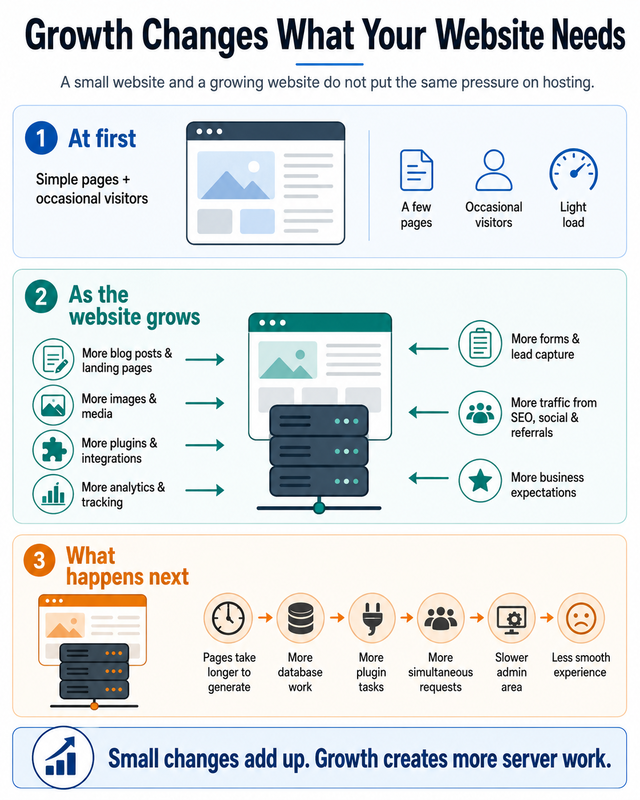
A small website and a growing website do not put the same pressure on hosting.
At first, the site may only need to handle simple pages and occasional visitors. But over time, more things are added:
more blog posts and landing pages;
more images and media files;
more plugins and integrations;
more analytics and tracking scripts;
more contact forms or lead capture tools;
more traffic from SEO, social media, or referrals;
more business expectations from the website.
Each of these additions may look small on its own. Together, they create more work for the server.
A website that was once simple can slowly become heavier. Pages take longer to generate. The database has more to process. Plugins run more tasks. Visitors make more simultaneous requests. The admin area becomes slower. The site starts feeling less smooth than it did at the beginning.
This is the moment when cheap hosting may stop feeling cheap.
The limits are not always visible at first
One reason cheap hosting is difficult to judge is that the problem does not always appear as a clear failure. The site may not go completely offline. It may not show an error message. It may not look broken.
Instead, the signs are softer:
pages feel slower during busy moments;
the site performs differently at different times of day;
the admin dashboard becomes frustrating;
forms or checkout steps feel less reliable;
optimization plugins stop making a big difference;
traffic grows, but leads or sales do not grow at the same pace.
These signs are easy to misread.
A business owner may think the problem is design, copywriting, traffic quality, or user interest. Sometimes those things matter. But if the site is slow or unstable, the hosting setup may be reducing the value of everything else.
You can bring in better traffic. You can publish stronger content. You can improve your offer. But if the website cannot respond quickly when people arrive, part of that effort is wasted.
Cheap hosting can create a growth ceiling
Cheap hosting is not always bad. For a small personal site, a test project, or a simple early-stage website, it may be enough. The problem begins when the website becomes part of business growth.
A growing website needs more than “it opens eventually.”
It needs consistent performance. It needs stable server response. It needs enough resources to handle visitors, plugins, database activity, forms, product pages, or checkout steps. It needs to stay reliable when traffic increases.
If the hosting setup cannot support that growth, it becomes a ceiling.
That ceiling may show up as:
weaker user trust;
lower conversion rates;
missed leads;
slower publishing and backend work;
poor performance during campaigns;
lost value from SEO or social traffic;
more time spent troubleshooting technical issues.
The hosting bill may still look low, but the hidden business cost can become much higher than the monthly savings.
Why this matters for business websites
A business website is not just a collection of pages. It is often part of how customers discover, evaluate, and contact the business.
If the site is slow, people may leave before understanding the offer. If forms hesitate, potential clients may not submit them. If product pages feel heavy, buyers may lose confidence. If the admin area is slow, the team spends more time making simple updates.
That is why hosting should not be judged only by price.
A low monthly cost is useful only if the website still supports the job it is supposed to do. If the site starts losing traffic value, trust, leads, or sales because the hosting environment is too limited, then the cheaper option may become more expensive in practice.
The full breakdown of this problem is explained here:
https://volodymyrzh.medium.com/why-cheap-hosting-becomes-expensive-over-time-e08193b9387c
Final thought
Cheap hosting often looks fine when a website is small because the limits are not being tested yet. But growth changes everything. More content, more visitors, more plugins, and more business expectations create more pressure.
At that point, the real question is not only how much hosting costs each month.
The better question is whether the hosting setup can support the website your business is becoming, not just the website it used to be.
Comments
No comments yet. Be the first to comment!