The Difference Between Affordable Hosting and Limiting Hosting
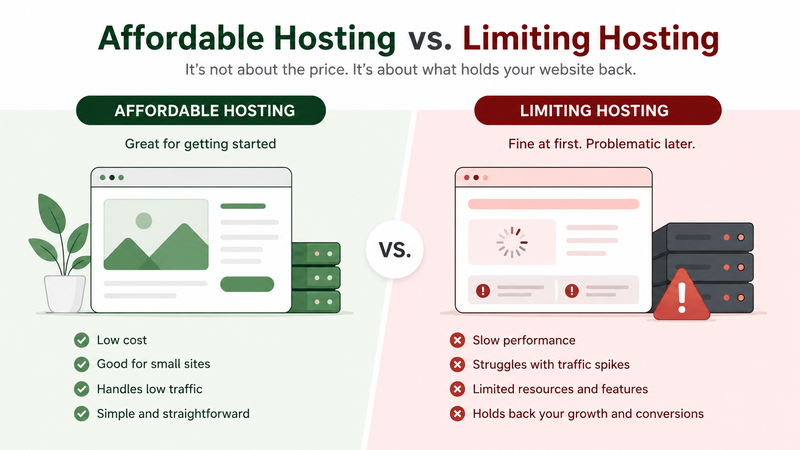
Low-cost hosting is not automatically a bad choice.
For many websites, affordable hosting is a practical starting point. A small business site, a personal blog, a simple portfolio, or a new project does not always need an expensive hosting setup from day one. Paying less at the beginning can be reasonable, especially when traffic is low and the site does not yet depend on complex features.
The real problem starts when affordable hosting becomes limiting hosting.
That difference matters. Affordable hosting helps a site stay online without unnecessary cost. Limiting hosting holds the site back when it needs more speed, stability, and room to grow.
Affordable hosting is not the enemy
It is easy to say that cheap hosting is always bad, but that is too simple.
A lower-cost hosting plan can be enough when the website is still lightweight. If the site has a few pages, simple content, limited traffic, and no heavy business logic, it may not need advanced infrastructure yet.
Affordable hosting can work well when:
the website is mostly informational;
traffic is still low;
pages are simple and mostly static;
there are not many plugins or third-party scripts;
the site does not depend on complex forms, checkout, or user accounts;
performance expectations are modest.
In this stage, paying much more for hosting may not create a visible business benefit. The website may load well enough, visitors may not experience serious delays, and the owner may prefer to invest money into content, design, advertising, or product development.
That is normal.
The issue is not the price itself. The issue is what happens when the website becomes more important to the business.
Limiting hosting starts when the site grows
A hosting plan becomes limiting when the website needs more resources than the plan can reliably provide.
This usually does not happen overnight. It happens gradually. The site grows, but the hosting environment stays the same.
More pages are published. More images are added. More plugins are installed. Analytics and marketing scripts are connected. Contact forms become more important. Traffic increases. The website starts receiving visitors from search, social media, email, or ads.
At first, everything still seems fine. Then small problems begin to appear:
pages take longer to load;
the admin area becomes slower;
forms feel delayed;
checkout becomes less smooth;
mobile users experience more waiting;
traffic peaks make the site unstable;
caching helps, but only partly;
optimization stops producing strong improvements.
This is where affordable hosting starts turning into limiting hosting.
The hosting bill may still look attractive, but the hidden cost appears elsewhere. Visitors wait longer. Campaign traffic performs worse. Search users bounce faster. Buyers lose confidence. Site owners spend more time trying to fix symptoms instead of solving the infrastructure problem.
I explained this broader business problem in more detail here: https://volodymyrzh.medium.com/why-cheap-hosting-becomes-expensive-over-time-e08193b9387c
The real question is not “Is it cheap?”
A better question is: does the hosting still support what the website is trying to do?
Cheap hosting is not always weak. Expensive hosting is not always right. The better test is whether the hosting fits the current stage of the website.
For example, a simple brochure site and a growing WooCommerce store do not have the same needs. A blog with occasional traffic and a landing page receiving paid traffic do not carry the same risk. A website with static pages and a website with dynamic forms, filters, accounts, payments, and tracking scripts create different pressure on the server.
Limiting hosting usually shows up when the website becomes more active.
It may need to handle:
more simultaneous visitors;
more database work;
more dynamic page generation;
more plugins and background tasks;
more external scripts;
more image-heavy pages;
more business-critical actions.
When hosting cannot keep up, the site may still technically “work.” But it works with friction.
That friction is what makes limiting hosting dangerous. The site does not always break completely. It simply becomes slower, less reliable, and less pleasant to use.
Why limiting hosting is easy to miss
Many hosting problems are easy to overlook because they do not always look like hosting problems.
A slow page may look like a design issue. A delayed checkout may look like a plugin problem. A weak mobile experience may look like an image optimization issue. A slow admin area may look like WordPress being WordPress.
Sometimes those explanations are partly true. But they may not be the full story.
If the website has already been optimized and still feels slow, hosting should be part of the review. If performance gets worse during traffic peaks, hosting should be checked. If dynamic pages are much slower than simple pages, the server environment may be struggling.
This is especially important for websites that support revenue, leads, bookings, sales, or client trust. In that context, hosting is not just a technical cost. It becomes part of the user experience.
A visitor does not care whether the problem comes from the server, plugin stack, scripts, cache, or database. They only feel that the site is slow.
Affordable is fine until it blocks progress
The best way to think about hosting is by stage.
At the early stage, affordable hosting can be a smart choice. It keeps costs low while the website is still simple.
At the growth stage, the same hosting may become too restrictive. The site may need more server resources, better stability, stronger caching, cleaner limits, or a more reliable setup for dynamic pages.
At the business-critical stage, hosting should not be chosen only by price. It should be judged by how well it protects traffic, conversions, and user experience.
That does not mean every website needs premium hosting immediately. It means site owners should recognize when the old plan no longer matches the new reality of the website.
Final thoughts
Affordable hosting helps when it matches the website’s size and purpose. Limiting hosting hurts when it blocks speed, reliability, growth, and user trust.
The difference is not always visible on the invoice. It becomes visible in how the website feels to users.
If the site is small, simple, and low-risk, affordable hosting may be enough. But if the site is growing, attracting real visitors, supporting campaigns, or handling sales and leads, hosting should be reviewed as part of the business system.
Low price is not the problem.
The problem is when the hosting saves money on the bill while quietly costing more through slow pages, weaker conversions, and lost growth.
Comments
No comments yet. Be the first to comment!