When Hosting Becomes a Business Bottleneck

Hosting usually starts as a simple technical decision. You choose a plan, connect your domain, install WordPress, publish the first pages, and move on to the “real” work: content, design, SEO, ads, offers, products, and customer communication. At the beginning, this feels completely normal because the website does not yet create much pressure on the server.
A small site with a few pages can often run well on a basic hosting plan. It may load quickly enough, the admin area may feel acceptable, and there may be no obvious reason to think about infrastructure. The hosting account sits quietly in the background while the business focuses on growth.
But this is exactly why hosting problems can be so easy to miss.
As the website becomes more useful, it also becomes heavier. More people visit it. More content is published. More plugins are added. More forms, scripts, images, analytics tools, and marketing features are connected. The site is no longer just an online brochure. It becomes part of the business system.
At that point, hosting can stop being just a background service.
It can become a business bottleneck.
A bottleneck does not always look like a broken website
When people imagine a hosting problem, they often think about a website going completely offline. But in many cases, the problem is much quieter. The site still opens. The homepage still loads. The admin area still works. Nothing looks completely broken.
The issue is that everything starts requiring more patience.
A page loads, but slower than expected. The WordPress dashboard opens, but feels heavy. Publishing a new article works, but takes longer than it should. A form submits, but the confirmation message appears late. A landing page gets traffic, but visitors do not move forward as often as expected.
This kind of bottleneck is dangerous because it is easy to normalize. You get used to waiting. You tell yourself that the site is “fine enough.” You assume the problem is caused by a plugin, a theme, an image, or a temporary traffic spike.
Sometimes that is true.
But sometimes the real issue is that the hosting plan no longer matches what the website is trying to do.
Common signs include:
pages that feel slower during busy hours;
a WordPress admin area that becomes heavier over time;
forms, dashboards, or checkout pages that respond inconsistently;
plugin updates that create more stress than they should;
traffic growth that does not lead to proportional growth in leads or sales;
optimization work that helps a little, but never fully solves the issue.
The website may still be online, but it is no longer moving smoothly. That is the first warning sign.
Growth adds pressure to every part of the site
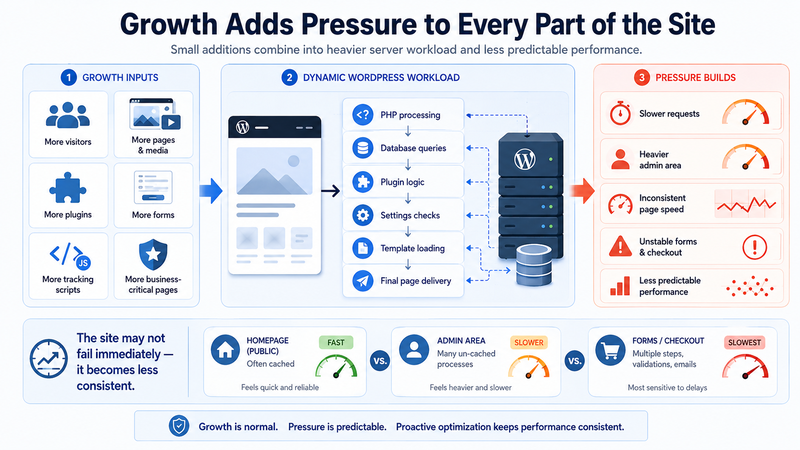
A growing website does not become heavier because of one single change. It usually happens through many small additions. Each new page, image, script, form, plugin, and tracking tool adds a little more work for the server. One change may not matter much. Dozens of changes together can create real pressure.
This is especially true for WordPress websites because many parts of the page are generated dynamically. The server may need to process PHP, query the database, run plugin logic, check settings, load templates, and send the final page to the visitor. If the hosting environment is weak or overcrowded, this process can become slower as the site grows.
Growth can add pressure through:
more visitors making requests at the same time;
more posts, pages, and media files stored on the site;
more database queries from plugins and dynamic content;
more background tasks, backups, scans, and scheduled actions;
more third-party scripts for analytics, ads, forms, chat, and tracking;
more business-critical pages such as landing pages, checkout pages, and lead forms.
The site may not fail immediately. Instead, performance becomes less predictable. Some pages load normally, while others feel slow. The homepage may be cached and fast, but the admin area feels heavy. Blog posts may work, but contact forms or WooCommerce pages feel unstable.
That inconsistency is often where the bottleneck becomes visible.
The business cost appears before the technical failure
The biggest mistake is treating hosting performance as only a technical issue. Slow hosting does not just affect server charts. It affects how people experience the business.
A visitor does not know whether the delay comes from CPU limits, database load, plugin overhead, shared resources, or poor caching. They only feel that the website is slow or awkward. That feeling can change what they do next.
They may leave before reading the full page. They may avoid filling out the form. They may hesitate before clicking a button. They may not trust the checkout experience. They may choose a competitor because that site feels easier to use.
The business cost can show up in several places:
fewer leads from the same amount of traffic;
weaker conversion rates on landing pages;
lower trust during the first visit;
more abandoned carts or unfinished forms;
slower content production because the admin area is frustrating;
weaker campaign results because paid or social traffic lands on a slow page.
This is why hosting can become a bottleneck even when the site is technically “working.” The business is not only paying for hosting. It is depending on hosting to support the user journey.
If that infrastructure is too weak, the website may quietly waste traffic.
Cheap hosting can become expensive later
Cheap hosting is not automatically bad. For a small project, early test site, personal blog, or simple static-style website, a low-cost plan may be a reasonable starting point. The problem begins when the same plan is expected to support a more serious business role.
A website that brings traffic, leads, sales, bookings, or customer trust needs a different level of reliability. It needs enough resources to handle growth. It needs stable performance during important moments. It needs an admin area that does not slow down basic work. It needs room for content, plugins, forms, and future marketing activity.
The hidden cost appears when a cheap hosting plan saves a few dollars per month but limits everything around it.
That can mean slower SEO progress, weaker conversion results, more technical frustration, and more time spent fixing symptoms instead of growing the site. In that situation, the lowest monthly price is not really the cheapest option. It is just the easiest cost to see.
For a deeper explanation of this pattern, read the full article here:
https://volodymyrzh.medium.com/why-cheap-hosting-becomes-expensive-over-time-e08193b9387c
The better question to ask
The question is not only whether the website can run on cheap hosting. Many websites can run on cheap hosting for a while. The better question is whether that hosting can support what the website is supposed to do next.
Can it handle more traffic? Can it support more content? Can it keep forms and landing pages responsive? Can it handle WooCommerce, membership features, booking tools, or lead generation systems? Can it remain stable when the website becomes more valuable to the business?
If the answer is no, then hosting is no longer a small technical detail.
It has become a growth constraint.
A good hosting setup does not guarantee business success by itself. But a weak hosting setup can quietly limit the success that your content, SEO, design, and marketing are trying to create.
Comments
No comments yet. Be the first to comment!