How Teams Turn Brand Voice Notes Into Repeatable Content Decisions
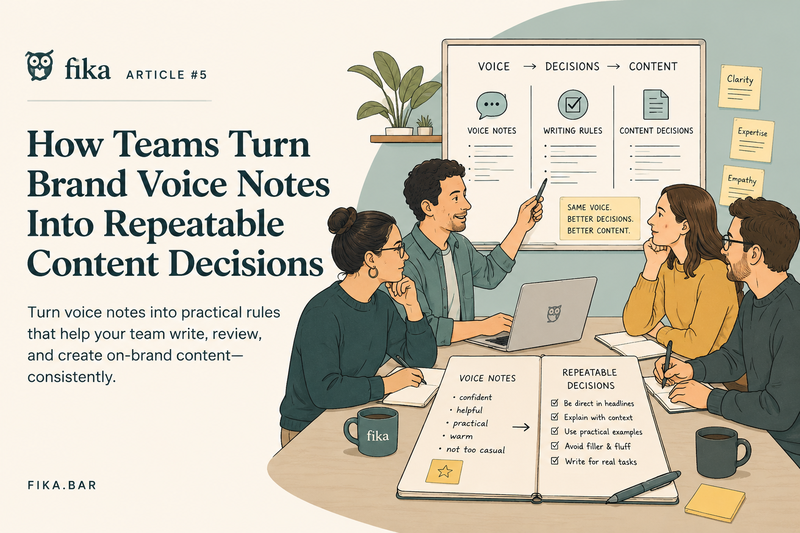
Brand voice often starts as a set of notes.
A founder writes down a few preferences. A marketer collects examples from old campaigns. A content lead adds comments like “more confident,” “less generic,” “warmer,” or “more practical.” Someone creates a document with tone adjectives, sample phrases, and a few reminders about how the brand should sound.
That is a useful start.
But notes are not the same as decisions.
A team can have many good brand voice notes and still struggle to use them while writing, reviewing, editing, briefing freelancers, or prompting AI tools. The problem is not always that the team lacks voice guidance. The problem is that the guidance has not been turned into repeatable content decisions.
That gap matters because content teams do not work inside abstract voice theory. They work inside real choices:
Should this headline sound direct or softer?
Should this email explain more or get to the point faster?
Should this article sound expert, friendly, practical, or more strategic?
Should the writer use casual phrasing or keep the tone more professional?
Should the review comment say “make it better,” or point to a specific rule?
Brand voice becomes useful when it helps people make these decisions consistently.
Why brand voice notes often fail inside a team
Brand voice notes usually fail for one simple reason: they describe the desired sound, but they do not explain what to do with it.
A note like “we sound helpful and expert” may be accurate. It may even be true to the brand. But it does not automatically tell a writer how to structure an introduction, how much explanation to include, what kind of examples to use, or how to avoid sounding generic.
A note like “avoid sounding too corporate” can also be useful. But without examples or decision rules, every person may interpret it differently. One writer may make the copy warmer. Another may make it casual. Another may remove structure. Another may add jokes. The team then spends time fixing tone drift instead of improving the content itself.
This is why voice notes need to be translated into content behavior.
For example, instead of only saying:
“Sound practical.”
A usable rule would say:
“When explaining a concept, connect it to a real content task, such as writing a landing page, reviewing an AI draft, preparing a brief, or giving feedback to a writer.”
That turns a vague preference into a repeatable decision.
What repeatable content decisions look like
Repeatable content decisions are small rules that help different people make similar choices without asking for approval every time.
They do not need to be complicated. In fact, the best ones are usually simple.
A practical brand voice system can define decisions such as:
how direct the opening should be;
when to use examples;
when to explain the reasoning behind a recommendation;
when to avoid casual language;
how to describe problems without sounding negative;
how to make advice useful instead of generic;
how to review tone without relying on personal taste.
These decisions help the team move from “I think this sounds right” to “this follows the agreed voice logic.”
That shift is important. Personal taste is hard to scale. A repeatable rule can be shared, reviewed, improved, and reused.
Turning notes into writing rules
The first step is to separate voice description from writing behavior.
A voice description explains the brand’s intended personality.
A writing rule explains how that personality appears in actual content.
For example:
Voice note: Clear and practical.
Writing rule: Explain the action a reader can take, not only the idea behind it.
Voice note: Expert but not cold.
Writing rule: Use confident explanations, but include context that helps a non-specialist understand the point.
Voice note: Friendly but not casual.
Writing rule: Keep the sentence flow approachable, but avoid slang, forced jokes, or overly familiar phrasing.
Voice note: Strategic.
Writing rule: Connect content choices to business outcomes, such as consistency, trust, conversion, onboarding, or revision time.
This is where a template pack can help. A structured template forces the team to move from loose notes into sections that can actually guide work: voice traits, boundaries, examples, review criteria, and practical usage rules.
For a deeper breakdown of how this can be organized, the assigned use case is here:
The decision layer most teams miss
Many teams jump from brand voice adjectives directly into writing.
That creates a missing middle layer.
The team knows how the brand should feel, but not how that feeling should influence daily choices. The missing layer is the decision layer.
This layer answers questions like:
What does “confident” mean in a headline?
What does “helpful” mean in a product explanation?
What does “professional” mean in a social post?
What does “simple” mean in a technical article?
What does “not too salesy” mean in a call-to-action?
Without this layer, people improvise. With it, they can make aligned choices faster.
For example, a content team may decide:
“Confident” does not mean exaggerated claims. It means clear recommendations, specific reasoning, and no unnecessary hedging.
That one rule can affect headlines, intros, product copy, blog conclusions, and review comments.
The team may also decide:
“Helpful” does not mean long explanations everywhere. It means giving enough context for the reader to act without confusion.
That prevents the voice from becoming bloated or overly instructional.
How this improves content review
Repeatable voice decisions are especially useful during review.
Without clear rules, feedback often becomes subjective:
“This feels off.”
“Can we make it warmer?”
“It sounds too generic.”
“This does not sound like us.”
“Make it more human.”
These comments may be understandable, but they are not very useful for revision. The writer still has to guess what to change.
A better review comment connects the issue to a rule:
“This introduction explains the topic, but it does not connect the problem to a real content workflow. Add a practical scenario so the article feels more useful.”
Or:
“This paragraph sounds confident, but it makes a broad claim without showing the reasoning. Add one sentence that explains why this matters for team consistency.”
Or:
“This section is friendly, but too casual for our brand. Keep the approachable structure, but remove the slang and make the explanation more precise.”
This kind of feedback is easier to apply. It also teaches the writer how the voice works, instead of only correcting one draft.
How teams can convert existing notes into decisions
A team does not need to throw away its current voice notes. Most of the useful material is probably already there. The task is to reorganize it.
A simple process can look like this:
Collect the existing voice notes, examples, feedback comments, and preferred phrases.
Group them by repeated themes: clarity, confidence, warmth, expertise, simplicity, authority, empathy.
For each theme, ask: “What should a writer do differently because of this?”
Turn each answer into a rule.
Add one good example and one weak example for each rule.
Use those rules during briefing and review.
Update the document when the team finds a recurring content problem.
The goal is not to create a long document. The goal is to create a document people can use while working.
That is why the previous Fika article focused on making voice rules easy to apply during writing:
This article continues the same idea from a team workflow angle. A rule is useful only when it helps more than one person make the same kind of content decision.
A practical example
Imagine a team has this brand voice note:
“We want to sound clear, useful, and experienced.”
That sounds reasonable, but it is too broad for daily writing.
The team could turn it into these decisions:
Clear
Use direct section headings. Avoid abstract intros. Explain the problem before the solution.
Useful
Include practical examples. Show how the idea affects writing, reviewing, briefing, or editing.
Experienced
Do not over-explain obvious concepts. Focus on the mistakes teams actually make and how to prevent them.
Now the writer knows what to do. The editor knows what to check. The content lead knows how to brief future assignments. The same voice note becomes part of the workflow.
Why this matters when several people create content
Brand voice problems become more visible as the team grows.
One person can often keep the voice consistent by instinct. A founder, solo marketer, or senior content lead may know what “right” sounds like. But as more people join the process, instinct is no longer enough.
The team may include:
internal writers;
freelance writers;
editors;
designers;
social media managers;
SEO specialists;
AI tools;
subject-matter experts;
managers giving feedback.
Each person touches the voice from a different angle. If the guidance is only descriptive, every person adds their own interpretation. If the guidance is decision-based, the team has a shared reference point.
That does not remove judgment. It improves judgment.
People still need to think. But they are not starting from personal preference each time.
The real value of a practical voice document
A practical brand voice document is not valuable because it sounds polished. It is valuable because it reduces repeated uncertainty.
It helps the team answer the same types of questions faster:
What should this content sound like?
What should we avoid?
What makes this draft feel on-brand?
What makes this section too generic?
What should the writer change first?
How do we explain tone feedback clearly?
When a document answers those questions, it becomes part of production. It supports briefs, drafts, edits, reviews, AI prompts, onboarding, and content updates.
That is the point where brand voice stops being a branding note and becomes an operating system for content decisions.
Final takeaway
Brand voice notes are useful, but they are only the beginning.
A team needs more than a list of adjectives, examples, and preferences. It needs a way to turn those notes into choices people can repeat across articles, landing pages, emails, product copy, social posts, and review comments.
The practical question is not only:
“What should our brand sound like?”
The better question is:
“What decisions should our team make differently because of this voice?”
When that question is answered clearly, brand voice becomes easier to use, easier to review, and easier to keep consistent as more people create content.
Comments
No comments yet. Be the first to comment!