How Website Speed Shapes Buyer Confidence
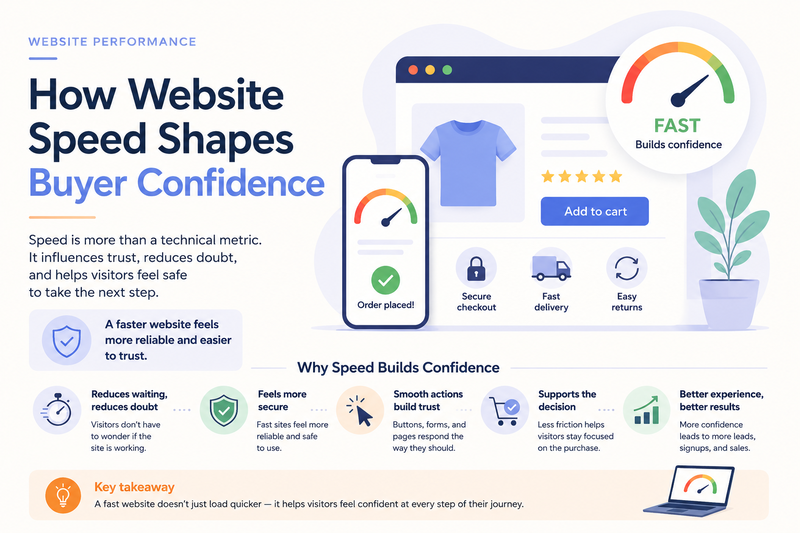
Website speed does not only affect how quickly a page appears. It also affects how confident visitors feel while using the site.
A fast website feels easier to trust. Pages open smoothly. Buttons respond when clicked. Forms do not feel stuck. Checkout steps move without confusion. The visitor does not have to stop and wonder whether the website is working properly.
That matters because confidence is fragile online. Visitors cannot see the people behind the business. They cannot inspect the server, the process, or the internal system. They judge the experience through what the website shows them.
Speed is one of those signals.
Slow websites create doubt
A slow website gives visitors more time to question their decision.
When a page takes too long to respond, the visitor may start thinking about whether the company is reliable. If a form freezes, they may wonder whether the message will be delivered. If checkout delays, they may worry about payment safety. If a product page feels unstable, they may compare the store with another option.
The delay may be technical, but the reaction is emotional.
Slow performance can create doubts like:
Is this website still working?
Is this business reliable?
Will my form submission go through?
Is checkout safe?
Will the order be processed correctly?
Should I leave and try another site?
These questions can appear quickly. The visitor may not analyze hosting, scripts, database queries, or server response time. They simply feel that the site is not smooth enough.
Confidence grows when the site feels stable
A fast website does not automatically make a weak offer strong. It does not replace clear pricing, useful product information, good copy, or a trustworthy brand. But it helps the visitor move through the page without unnecessary friction.
When the site feels stable, the visitor can focus on the offer. They can read, compare, choose, submit, book, or buy. The website stays in the background instead of becoming the problem.
This is especially important on pages where the visitor is close to action:
landing pages;
contact forms;
product pages;
carts;
checkout pages;
booking forms;
quote request pages.
These pages carry more pressure than a simple informational article. If they are slow, the visitor may hesitate at the exact moment when confidence matters most.
Checkout is where confidence becomes critical
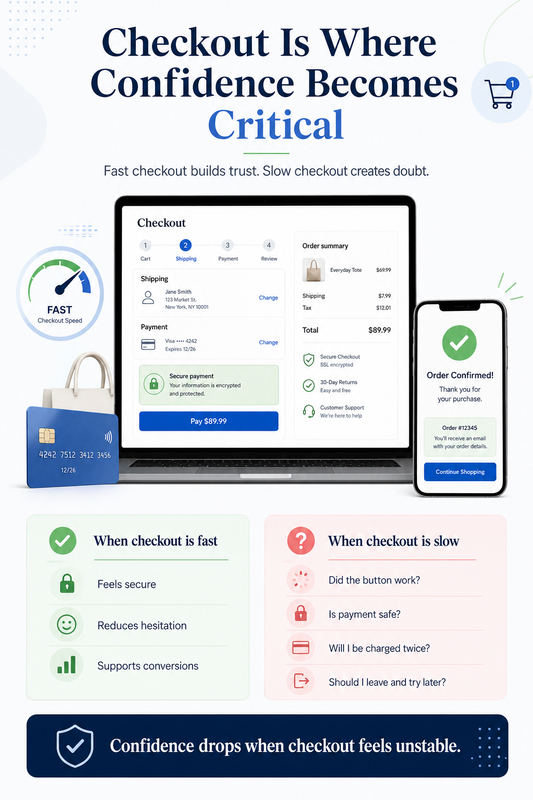
Checkout speed is one of the clearest examples.
A customer who reaches checkout has already made several decisions. They have looked at the product, accepted the price, added the item to the cart, and moved toward payment. That does not mean the sale is guaranteed. It means the customer is close enough that friction becomes more expensive.
A slow checkout can make the customer feel uncertain. If payment options load slowly or confirmation takes too long, the customer may wonder whether something went wrong.
This previous Fika article explains why checkout speed matters so much at the final step of the buyer journey:
The same idea applies beyond ecommerce. Any conversion action becomes weaker when the website feels slow or unstable.
Speed supports trust before the visitor thinks about it
Most visitors do not consciously say, “This website has good server performance.” They simply experience the site as smooth, clear, and dependable.
That feeling can support trust before the visitor reads every detail. It can make the business feel more prepared. It can make the offer feel easier to act on. It can reduce the small doubts that often appear before a decision.
A slow website does the opposite. It makes the visitor notice the system instead of the offer. Once that happens, the website has to work harder to keep attention.
This is why speed should not be treated only as a technical metric. It is also part of user confidence.
Performance problems can weaken the whole journey
A website journey usually has several steps. A visitor may enter through a blog post, move to a service page, read a comparison, open a contact form, or reach checkout. Each step needs enough confidence to continue.
If one step feels slow, the visitor may still move forward. If several steps feel slow, the whole journey starts to feel risky.
Common confidence-breaking moments include:
a page that takes too long to respond;
a button that does not react quickly;
a form that delays after submission;
a cart that updates slowly;
a checkout step that feels frozen;
a confirmation message that appears too late.
These small moments can quietly reduce conversions. They may not always show up as obvious errors. The website may technically work, but the experience may still feel weak.
Better speed protects buyer momentum
Buyer confidence is closely connected to momentum.
When visitors move smoothly from interest to action, they are less likely to overthink every step. When the site slows down, that momentum breaks. The visitor has more time to reconsider, compare, or leave.
This does not mean every website needs the most expensive hosting or the most advanced performance setup. It means the site should be strong enough for the work it is expected to do.
A small website may only need basic optimization and stable hosting. A growing site with more traffic, plugins, forms, ecommerce features, and dynamic pages may need more careful performance planning.
For a broader look at how speed affects trust, leads, checkout behavior, and sales, this guide explains the conversion side in more detail:
https://medium.com/@wwwebadvisor/how-website-speed-affects-conversions-489751a34a01
The main point is simple: speed helps visitors feel safe enough to continue.
A slow website can make even a good offer feel uncertain. A fast, stable website helps the visitor stay focused on the next step.
Comments
No comments yet. Be the first to comment!