How Much Solar Power Can You Really Generate in One Day?
Solar panels promise a simple way to produce electricity without relying entirely on the grid. Whether you're preparing for power outages, planning a camping trip, or building a small off-grid system, the idea is appealing: place a panel in sunlight and start generating power.
But how much electricity can a solar panel actually produce in one day?
A 200W solar panel doesn't necessarily generate 200 watts throughout the day. A 500W panel won't continuously deliver 500 watts from sunrise to sunset, either. Real-world solar production depends on several variables, including your location, season, weather, panel orientation, temperature, and charging equipment.
Understanding these factors helps you estimate daily energy production more accurately and avoid buying equipment that cannot meet your needs.
Let's examine how solar output works, calculate several realistic examples, and explore what those numbers mean for everyday electricity use.
Solar Panel Wattage vs. Daily Energy Production
The first important distinction is between power and energy.
Watts (W) measure the amount of electrical power a solar panel produces at a particular moment.
Watt-hours (Wh) measure the total amount of electrical energy generated over time.
For example, if a solar panel produces a steady 150 watts for four hours, it generates:
150W × 4 hours = 600Wh
That's equivalent to 0.6 kilowatt-hours (kWh).
A solar panel rated at 200W has a nominal maximum output of approximately 200 watts under standardized test conditions. That doesn't mean it will produce 200 watts continuously during daylight hours.
In fact, output changes throughout the day.
Early in the morning, sunlight arrives at a relatively low angle. As the sun rises, irradiance generally increases, reaching higher levels around midday. Production then declines as the sun approaches the horizon.
Clouds, nearby buildings, trees, and other obstacles can make the pattern considerably less predictable.
This explains why solar production is better measured in watt-hours per day rather than simply comparing panel wattages.
What Are Peak Sun Hours?
One of the most useful concepts for estimating daily solar production is Peak Sun Hours (PSH).
A peak sun hour represents an amount of solar energy equivalent to receiving sunlight at an irradiance of 1,000 watts per square meter for one hour.
Importantly, peak sun hours don't represent the number of hours the sun is visible.
You might have 12 hours of daylight but only four equivalent peak sun hours.
For example, sunlight during the morning and evening is usually less intense than sunlight around midday. Peak sun hours combine those varying conditions into an equivalent period of full-strength solar irradiance.
The number of peak sun hours depends on your geographical location, time of year, and local weather patterns.
For illustration, consider three hypothetical daily conditions:
Limited solar availability: 2 peak sun hours per day.
Moderate solar availability: 4 peak sun hours per day.
Strong solar availability: 6 peak sun hours per day.
These are calculation scenarios, not guaranteed daily values or forecasts for a particular location.
Solar production also depends on how much of the available sunlight reaches the panel at its actual orientation and tilt.
The Basic Formula for Daily Solar Energy
You can estimate solar production using a straightforward calculation:
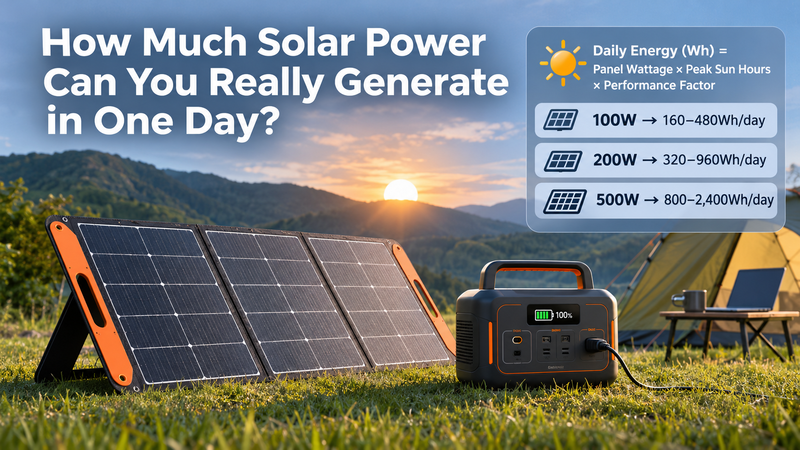
Daily Energy (Wh) = Panel Wattage × Peak Sun Hours × Performance Factor
The performance factor represents the portion of theoretical energy that becomes usable energy at the chosen measurement point.
For an illustrative solar-to-battery calculation, we'll use a factor of 0.80.
This assumes a combined 20% reduction due to panel operating conditions and charging-system losses. It isn't a universal efficiency rating, and actual results may be higher or lower.
Let's calculate the output of three example systems under different sunlight conditions.
100W Solar Panel
A small 100W panel could theoretically deliver the following daily energy under our assumptions:
2 peak sun hours: 160Wh
4 peak sun hours: 320Wh
6 peak sun hours: 480Wh
200W Solar Panel
A 200W solar panel provides twice the nominal capacity of a 100W panel.
Estimated daily production:
2 peak sun hours: 320Wh
4 peak sun hours: 640Wh
6 peak sun hours: 960Wh
500W Solar Setup
A larger 500W solar setup offers considerably more potential energy production.
Estimated daily production:
2 peak sun hours: 800Wh
4 peak sun hours: 1,600Wh
6 peak sun hours: 2,400Wh
These figures are illustrative estimates based on a consistent 80% performance factor.
For instance, a 200W panel receiving four peak sun hours could produce approximately:
200 × 4 × 0.80 = 640Wh
A 500W array under the same assumptions could produce:
500 × 4 × 0.80 = 1,600Wh
However, this energy estimate shouldn't be confused with guaranteed electricity delivered to appliances.
Battery charging limits, storage capacity, inverter losses, and consumption during charging can all affect how much energy is ultimately available.
Why Solar Panels Rarely Produce Their Rated Power All Day
Solar panel ratings are measured under standardized laboratory conditions.
In outdoor environments, these conditions are constantly changing.
1. The Angle of Sunlight
Solar panels usually produce more electricity when sunlight strikes their surface closer to perpendicular.
A panel positioned flat on the ground may perform differently from the same panel tilted toward the sun.
Adjustable portable panels can be particularly useful because their position can be changed during the day.
However, frequent adjustments aren't always necessary or practical. Even one well-chosen orientation can improve results compared with placing a panel in an inconvenient shaded location.
2. Temperature
Solar panels need sunlight, but higher cell temperatures can reduce their electrical efficiency.
This creates a somewhat surprising situation: a bright, cool day can sometimes be more favorable for photovoltaic performance than an extremely hot day with similar sunlight intensity.
The exact reduction depends on the panel's temperature coefficient and operating conditions.
3. Clouds and Changing Weather
Cloud cover can significantly reduce solar irradiance.
Thin clouds may cause relatively modest reductions, while dense cloud cover can reduce output dramatically.
Solar panels can still generate electricity under diffuse daylight, but production is generally much lower than under strong direct sunlight.
A solar system designed around consistently sunny conditions may therefore struggle during several consecutive cloudy days.
4. Partial Shading
Even relatively small shadows can noticeably affect panel production.
Depending on the panel's electrical configuration, shading one section can influence the output of a larger group of cells.
When positioning portable solar panels, watch for shadows from:
Trees and branches
Buildings and fences
Parked vehicles
Camping equipment
Other panels or nearby objects
Remember that shadows move throughout the day.
A location that looks perfect at 10 AM may become partially shaded in the afternoon.
5. Conversion and Charging Losses
Electricity passes through different components before reaching a battery or electrical device.
Depending on the system, these may include cables, connectors, a charge controller, and battery charging electronics.
Every conversion stage can introduce losses.
For that reason, the solar energy reaching a panel is not identical to the energy ultimately stored in a battery.
How Much Can a 200W Solar Panel Generate in a Day?
A 200W solar panel is an interesting starting point for portable electricity generation.
It's relatively manageable in size and can support smaller energy needs when paired with compatible equipment.
Using our earlier assumptions, four peak sun hours and an 80% performance factor provide approximately 640Wh of daily energy delivered toward battery storage.
What does that mean in practical terms?
Consider a small off-grid setup with the following daily consumption.
Wi-Fi Router
Power consumption: 10W
Daily operating time: 10 hours
Daily energy: 100Wh
LED Lighting
Power consumption: 15W
Daily operating time: 5 hours
Daily energy: 75Wh
Laptop
Average power consumption: 50W
Daily operating time: 4 hours
Daily energy: 200Wh
Phone Charging
Estimated daily energy: 20Wh
Total daily energy consumption: 395Wh
In this example, a 200W solar panel generating an estimated 640Wh could theoretically cover the 395Wh energy budget.
That leaves approximately 245Wh before accounting for any additional losses between battery storage and the devices.
The result looks promising, but two conditions matter.
First, the solar electricity must be available when needed, either directly or through a battery.
Second, the charging equipment must be capable of accepting the panel's output.
A 200W panel does not automatically provide reliable power at night or during cloudy periods.
Solar generation and battery storage solve different parts of the problem.
What Changes When You Use a 500W Solar Setup?
A 500W solar setup offers considerably greater theoretical daily production.
With four peak sun hours and the same 80% performance factor:
500 × 4 × 0.80 = 1,600Wh
That's approximately 1.6kWh of energy under the assumed conditions.
Such a system may be better suited to higher daily electricity consumption, larger portable battery systems, and situations where limited daylight makes charging speed important.
Imagine a household backup arrangement with the following simplified daily energy requirements:
Internet equipment: 240Wh
Laptop and electronics: 300Wh
LED lighting: 100Wh
Refrigerator: 600Wh
Total daily electricity requirement: 1,240Wh
In this hypothetical scenario, a 500W solar setup producing 1,600Wh might generate enough energy to cover the listed daily demand, assuming suitable storage and manageable additional conversion losses.
But this doesn't guarantee uninterrupted operation.
A refrigerator's electricity consumption varies substantially by model, ambient temperature, door-opening frequency, and compressor activity.
Its startup power requirement may also be much higher than its average running power.
A compatible battery system and inverter must be able to handle both the total energy requirement and the appliance's instantaneous power demand.
An important lesson follows:
More solar panel wattage can improve daily energy production, but it doesn't automatically solve every battery backup limitation.
If you're considering equipment in these power classes, the practical differences between portable panel options are explored in this more detailed comparison:
Jackery SolarSaga 200W vs 500 X: Which Solar Panel Should You Buy?
The right choice depends on your daily energy budget, charging opportunities, equipment compatibility, and portability requirements.
Why Battery Capacity Matters Just as Much as Solar Wattage
Suppose your solar equipment can generate 1,600Wh during a sunny day.
You might assume that all 1,600Wh will be available for later use.
But what happens if your battery has space for only 500Wh?
Once the battery reaches its maximum charge level, any excess solar electricity cannot be stored unless the system has another way to use or redirect that energy.
This is why solar generation capacity and battery storage capacity should be evaluated together.
A larger solar array may recharge a battery faster, but increasing panel wattage has diminishing benefits when the battery or charging system cannot absorb the additional energy.
Similarly, a large battery with insufficient solar input may require several days to recharge.
For daily off-grid use, you need a reasonable balance between:
Daily energy consumption, solar energy production, and available battery storage.
Let's consider a practical example.
Your essential devices consume 900Wh per day.
Your solar array produces an estimated 1,200Wh per day under favorable conditions.
At first glance, the energy balance is positive.
However, if tomorrow is cloudy and production falls to 250Wh, your energy deficit becomes:
900Wh − 250Wh = 650Wh
That deficit must come from previously stored battery energy or another electricity source.
This is why backup planning should include unfavorable weather conditions rather than relying only on average sunny-day production.
How Seasonal Changes Affect Solar Generation
Solar production changes throughout the year.
During summer, longer daylight hours and higher sun angles can support stronger daily energy production in many locations.
Winter introduces several challenges.
Days are shorter, the sun travels lower across the sky, and panels may receive less total solar radiation.
Snow, heavy cloud cover, and surrounding obstacles can further reduce usable output.
Nevertheless, cold temperatures alone don't make solar panels ineffective.
Photovoltaic cells can operate efficiently in cool conditions, provided sufficient sunlight reaches them.
The larger winter limitation in many regions is reduced solar exposure rather than temperature itself.
This seasonal difference becomes especially important when solar equipment is intended for emergency home backup.
A system capable of replacing your daily electricity consumption in summer may produce substantially less energy during winter.
For a more location-specific estimate, tools such as the National Renewable Energy Laboratory's PVWatts calculator can help evaluate expected solar production using local solar-resource data and system assumptions.
How to Estimate Your Own Solar Production
Instead of relying entirely on manufacturer examples or generic online estimates, you can create a calculation based on your situation.
Step 1: Identify Your Daily Energy Needs
List the devices you intend to power and calculate their daily energy consumption.
For devices with relatively constant electrical loads, multiply power consumption by operating hours.
For appliances with variable consumption, use measured daily energy where possible.
For example:
40W × 5 hours = 200Wh
Repeat the process for each device, then calculate the total.
Step 2: Estimate Your Local Peak Sun Hours
Use location-specific solar resource data.
If possible, check monthly values rather than using a single annual average.
Monthly data is particularly useful when the system will operate during winter or in areas with significant seasonal changes.
Step 3: Estimate Performance Losses
Include a reasonable allowance for real operating conditions.
The 80% factor used in this article is a calculation assumption, not a measured performance guarantee.
If your setup has significant shading, poor alignment, or additional conversion stages, your usable energy may be lower.
Step 4: Check the Charging System
Confirm that your battery or power station supports the proposed solar input.
Important technical characteristics include supported voltage range, maximum solar input power, connector compatibility, and any specific manufacturer restrictions.
Connecting an incompatible panel can result in poor performance or equipment damage.
Do not assume that panels are compatible simply because their advertised wattage looks suitable.
Step 5: Compare Daily Production With Consumption
Calculate whether your expected solar production is sufficient to meet your daily energy budget.
Then repeat the calculation using a less favorable sunlight scenario.
This second calculation is often more useful for backup planning than the optimistic estimate.
A Simple Three-Day Solar Backup Scenario
Imagine you're planning a three-day off-grid stay.
Your essential devices require 500Wh per day.
Total consumption:
500Wh × 3 days = 1,500Wh
You have a 200W solar panel and estimate the following daily production after your assumed solar-to-battery losses.
Day 1: Mostly Sunny
Peak sun hours: 5
Panel rating: 200W
Performance factor: 0.80
Estimated production: 800Wh
Day 2: Partly Cloudy
Peak sun hours: 2
Panel rating: 200W
Performance factor: 0.80
Estimated production: 320Wh
Day 3: Very Limited Sunlight
Peak sun hours: 1
Panel rating: 200W
Performance factor: 0.80
Estimated production: 160Wh
Total estimated solar production over three days: 1,280Wh
Your devices require 1,500Wh.
That creates a deficit of:
1,500Wh − 1,280Wh = 220Wh
A battery with sufficient usable stored energy could cover that gap.
However, this simplified result assumes the solar energy can actually be captured and used when available.
Real battery planning must also consider charging limits, discharge losses, the timing of electricity demand, and how much usable battery energy is available at the beginning of the trip.
This example demonstrates an important principle: even when a solar array generates less energy than your total demand, storage can help bridge temporary differences between production and consumption.
The reverse is also true. A system with plenty of solar production may still fail to power devices reliably if adequate storage isn't available at the right time.
Five Ways to Improve Daily Solar Production
Once you understand the basic calculations, improving performance becomes easier.
1. Prioritize direct sunlight.
A well-positioned panel with minimal shading may outperform a larger panel placed in an unfavorable location.
2. Adjust panel orientation when practical.
Portable panels offer flexibility, especially when the sun's position changes substantially during the day.
3. Keep the panel surface clean.
Dust, dirt, and other obstructions can reduce the amount of sunlight reaching photovoltaic cells.
4. Avoid unnecessary electrical losses.
Use manufacturer-approved cables and compatible charging accessories.
5. Measure actual production.
If your power station displays solar charging wattage or energy statistics, record performance under different weather conditions.
A few days of measurements can reveal whether your initial assumptions are realistic.
If you plan to rely on solar power regularly, measured results are more valuable than estimates based on ideal conditions.
Frequently Asked Questions
Can a 200W Solar Panel Generate 1kWh in One Day?
Yes, it's theoretically possible under favorable conditions, but it requires substantial daily solar exposure and relatively low system losses.
Using an 80% performance factor, generating 1,000Wh would require:
1,000 ÷ (200 × 0.80) = 6.25 peak sun hours
That amount of solar energy may be achievable in favorable locations and seasons, but it should not be treated as typical everywhere.
How Much Electricity Does a 500W Solar Setup Produce Daily?
Using the illustrative 80% performance factor, a 500W setup could generate approximately:
800Wh with two peak sun hours.
1,600Wh with four peak sun hours.
2,400Wh with six peak sun hours.
Actual output depends on location, weather, temperature, shading, system configuration, and charging limitations.
Do Solar Panels Work on Cloudy Days?
Yes. Solar panels can generate electricity from diffuse sunlight, but output is generally much lower during heavy cloud cover.
The amount varies with cloud thickness and changing atmospheric conditions.
Can I Use Solar Panels Without a Battery?
Yes, with suitable equipment designed for direct solar operation or grid-connected electricity generation.
However, portable solar systems often benefit from battery storage because the electricity demand of everyday devices does not always coincide with sunlight availability.
Is a Larger Solar Panel Always Better?
Not necessarily.
A larger panel or array can produce more electricity under equivalent conditions, but size, weight, portability, cost, charging limits, and daily consumption all influence whether the extra capacity is useful.
A smaller, well-matched system may be a better choice for modest electricity needs.
Final Thoughts
The amount of solar electricity you can generate in one day depends on much more than the wattage printed on the panel.
Peak sun hours, panel orientation, temperature, weather, shading, and charging losses all influence actual production.
For a simple estimate, multiply the solar panel's rated wattage by the number of equivalent peak sun hours and an appropriate performance factor.
But don't stop there.
Compare the resulting energy estimate with your daily electricity consumption, battery storage, and charging-system capabilities.
A 200W panel may be sufficient for basic electronics under favorable conditions. A larger 500W setup can provide considerably more energy, but only if the rest of the system can use it effectively.
Ultimately, the goal isn't to generate the highest possible number of watts at a particular moment.
It's to produce enough usable electricity, when you need it, to support the devices that matter.
Affiliate Disclosure: This article contains a link to related content that may include affiliate links. If you purchase through those links, the author may earn a commission at no additional cost to you.
Disclaimer: All solar generation, battery charging, and device consumption calculations in this article are illustrative estimates. Actual performance depends on environmental conditions, equipment specifications, system efficiency, and usage patterns. The examples should not be interpreted as guaranteed production, charging times, or backup runtimes.
Comments
No comments yet. Be the first to comment!