Why Low Hosting Price Is Not the Same as Low Total Cost
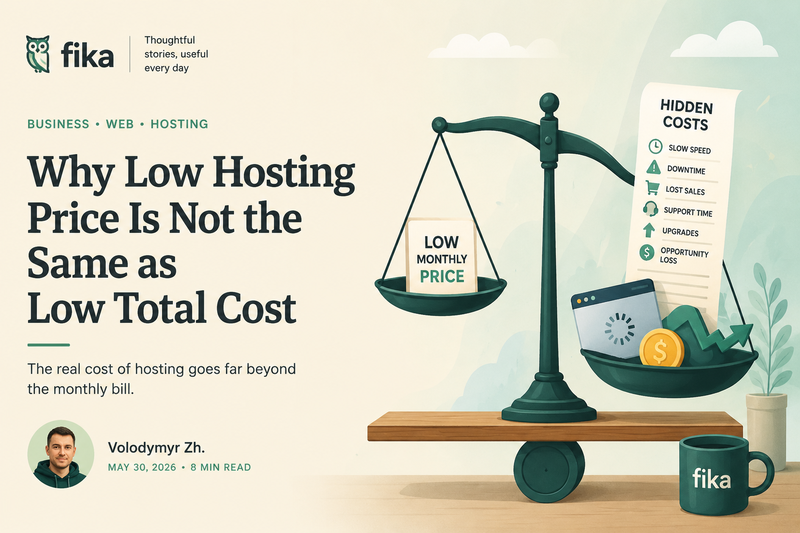
Cheap hosting can look like a smart decision when you only compare monthly prices. If one plan costs much less than another, the cheaper option feels easier to justify, especially for a small website, a new store, or a project that is still growing.
But hosting cost is not only the amount you pay every month. The real cost also includes what happens when the website becomes slow, unstable, difficult to manage, or unable to handle normal business growth.
This is especially important for WooCommerce and growing ecommerce websites. In the previous Fika article, I explained why WooCommerce performance is different from a normal WordPress website:
https://digitalowl.fika.bar/what-makes-woocommerce-performance-different-from-a-normal-w-01KS9ZQYGKAQWF1TPXVJPCN7YW
That difference matters because a store does not only display content. It handles products, prices, carts, checkout, customer accounts, stock rules, payment steps, and live actions. When hosting is too limited, these moving parts can become harder to support.
For a deeper related breakdown, read the full Medium article here:
https://volodymyrzh.medium.com/why-cheap-hosting-becomes-expensive-over-time-e08193b9387c
The monthly bill is only one part of the cost
Many website owners judge hosting by the invoice first. That is understandable. Hosting is a recurring expense, and nobody wants to overpay for resources they do not need.
But the monthly bill does not show the full picture.
A hosting plan can be cheap because it gives you limited resources, shared capacity, slower response under load, weaker support, or fewer tools for scaling. Those limits may not matter when the website is small and traffic is low. The problem appears later, when the website starts doing more work.
A business website may need to handle:
more visitors;
more landing pages;
more plugins;
more product pages;
more form submissions;
more checkout activity;
more tracking scripts;
more admin work;
more database activity.
At that point, the cheapest plan may still technically “work,” but it may no longer support the website well.
Slow performance creates hidden costs
A slow website does not always look broken. That is why the cost is easy to miss.
The site may still load. Pages may still open. Forms may still submit. Checkout may still function. But users may feel friction before anything obviously fails.
That friction can reduce results in quiet ways.
A visitor may leave before reading the full page. A buyer may hesitate during checkout. A lead may abandon a form. A returning user may lose trust. A marketing campaign may send traffic to a page that cannot respond quickly enough.
These are not always visible as “hosting problems” in analytics. They may appear as lower conversion rate, weak engagement, high bounce rate, abandoned carts, or disappointing campaign results.
The hosting bill remains low, but the business cost increases.
Cheap hosting can make good traffic less valuable
Traffic is not free, even when it comes from SEO.
You pay for traffic through content creation, link building, technical work, design, ads, social promotion, or time. If the website performs poorly after people arrive, part of that investment is wasted.
This is why hosting should not be judged separately from marketing.
A low-cost hosting plan may save a small amount every month, but if it weakens the performance of important pages, it can reduce the value of much larger efforts.
For example:
paid ads become less efficient if landing pages load slowly;
SEO traffic is less valuable if visitors leave quickly;
content marketing brings weaker results if pages feel unstable;
ecommerce traffic loses value if cart and checkout feel delayed;
support and admin work become harder if the backend is slow.
The real question is not only:
“How much does hosting cost?”
The better question is:
“How much value can the website preserve when visitors arrive?”
The problem often appears after growth starts
Cheap hosting is not always a mistake at the beginning. For a simple test project, small blog, early landing page, or low-traffic website, a basic plan may be enough.
The problem starts when the website grows but the infrastructure does not.
A site can become heavier because of more content, more plugins, more products, more tracking tools, more users, or more dynamic features. Even if the design looks the same, the work behind the page can increase.
This is especially visible with WordPress and WooCommerce. A basic content page can often be cached. But cart, checkout, account pages, filters, search, forms, and logged-in experiences often need live processing.
That means the server still matters.
When the site outgrows its hosting, the symptoms may include:
slower admin area;
inconsistent loading speed;
checkout delays;
database pressure;
failed or delayed form submissions;
slow product filters;
poor performance during traffic spikes;
more plugin conflicts under load.
At this stage, the low monthly price may be hiding a larger operational problem.
Affordable hosting is not the same as limiting hosting
This does not mean every website needs expensive hosting from day one. The point is not to choose the most expensive option.
The point is to choose hosting that matches the website’s current role and future pressure.
Affordable hosting can be a good decision when it provides enough resources, stable performance, clear upgrade paths, and reliable support. Limiting hosting becomes a problem when the plan is cheap because it cannot support what the site actually needs to do.
A better hosting decision considers:
current traffic;
expected traffic growth;
page type;
plugin weight;
ecommerce requirements;
database activity;
admin workload;
campaign plans;
support quality;
upgrade flexibility.
A small website and a growing WooCommerce store should not be evaluated the same way. Their performance risks are different.
When low price becomes expensive
Low hosting price becomes expensive when the website starts losing opportunities because of technical limits.
That does not always mean dramatic downtime. Sometimes the cost is more subtle:
visitors leave earlier;
buyers trust the store less;
forms convert worse;
paid campaigns underperform;
content brings less return;
admin tasks take longer;
technical fixes become more frequent;
the team spends more time working around limits.
These costs may not appear on the hosting invoice, but they still affect the business.
Final thought
Low hosting price and low total cost are not the same thing.
A cheap plan can be useful when the website is simple and the risk is low. But as a website grows, hosting becomes part of the business system. It affects speed, trust, conversion, admin work, and the value of traffic.
The best hosting choice is not always the cheapest one. It is the one that protects the website’s ability to do its job without quietly creating more expensive problems later.
Comments
No comments yet. Be the first to comment!